28 October 2026
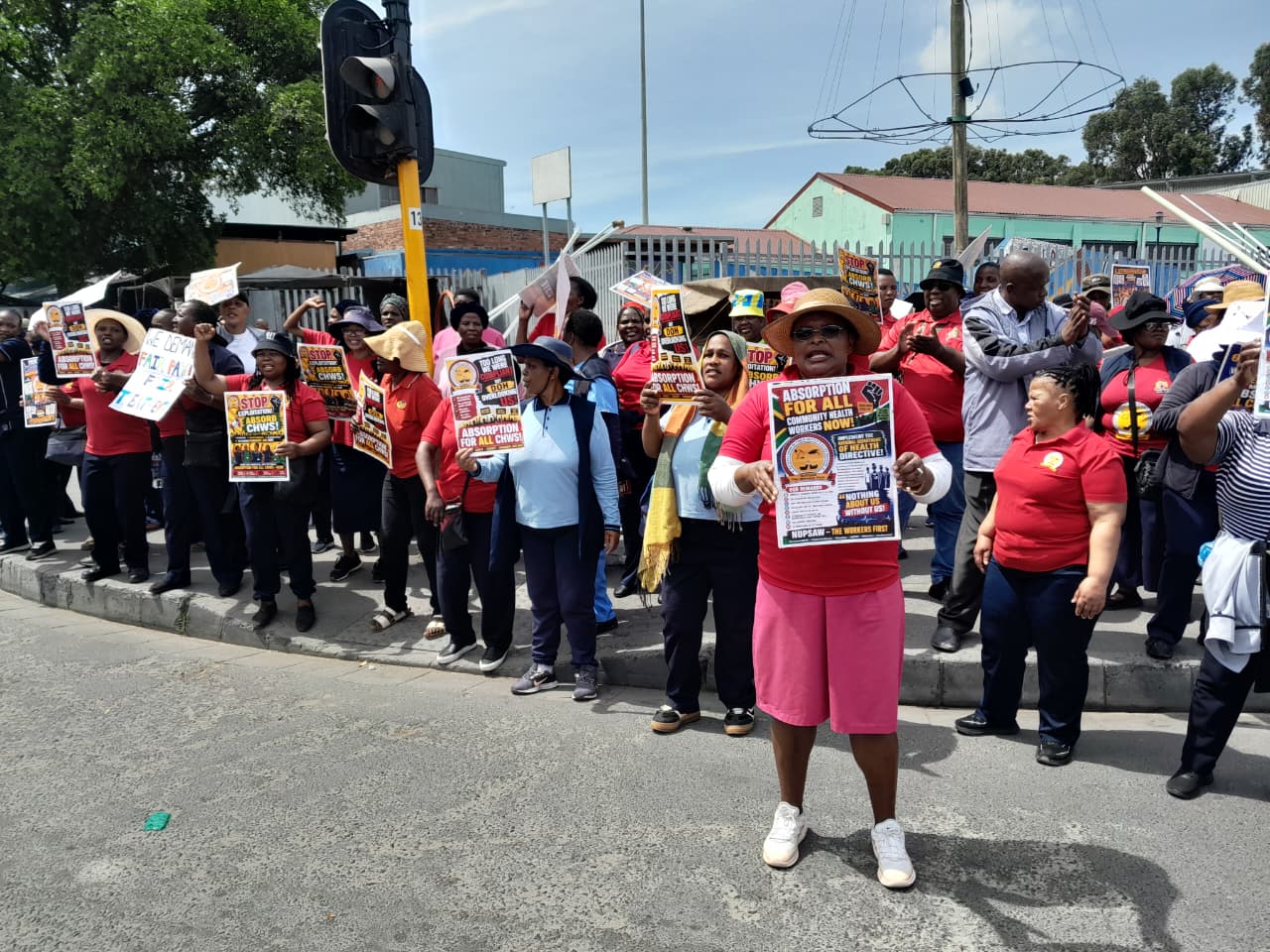
About 60 community health workers picketed outside the Zolani Centre in Nyanga on Tuesday, demanding to be insourced by government.  Photo: Vincent Lali
The National Union of Public Service and Allied Workers (NUPSAW) is approaching the Commission for Conciliation, Mediation and Arbitration (CCMA) to determine the legal “employer” of community health workers in the Western Cape.
Community health workers, supported by the union, have been staging protests across Cape Town this month to demand permanent jobs. They are currently employed by non-profit organisations (NPOs) contracted by the Western Cape Department of Health and Wellness.
The department told GroundUp that the province currently has no plans to permanently absorb them.
About 60 people picketed outside the Zolani Centre in Nyanga on Tuesday. Workers Groundup spoke to are employed by organisations operating in Lusaka, Lower Crossroads, KTC and New Rest.
“We will picket until we all get employed permanently. We want full absorption for all community health workers,” said Jabu Khanyile, provincial organiser at NUPSAW.
Asked how full absorption will change workers’ lives, he said: “We will have medical aid. Now we just drink water when we are sick.”
Khanyile said workers were concerned about job security every year when their contract came up for renewal. Some did not earn enough to cover expenses and their children had to rely on school feeding schemes.
Health worker Salaama Abrahams, said most of them earn R6,300 a month and were tired of working for NPOs which could refuse to renew their contracts.
Vuyani Shwane, NUPSAW’s provincial office manager, said the union had referred the dispute to the CCMA under section 200A of the Labour Relations Act, asking it to decide who the workers’ employer is, regardless of what their written contracts state.
Dwayne Evans, spokesperson for the department, said the services of the community health workers were procured “through an open, competitive tender process”. The department provided funding for the workers’ stipends, “taking into account applicable national minimum wage requirements”, and the contracted NPOs were responsible for employing and managing them them, Evans said.