12 June 2026
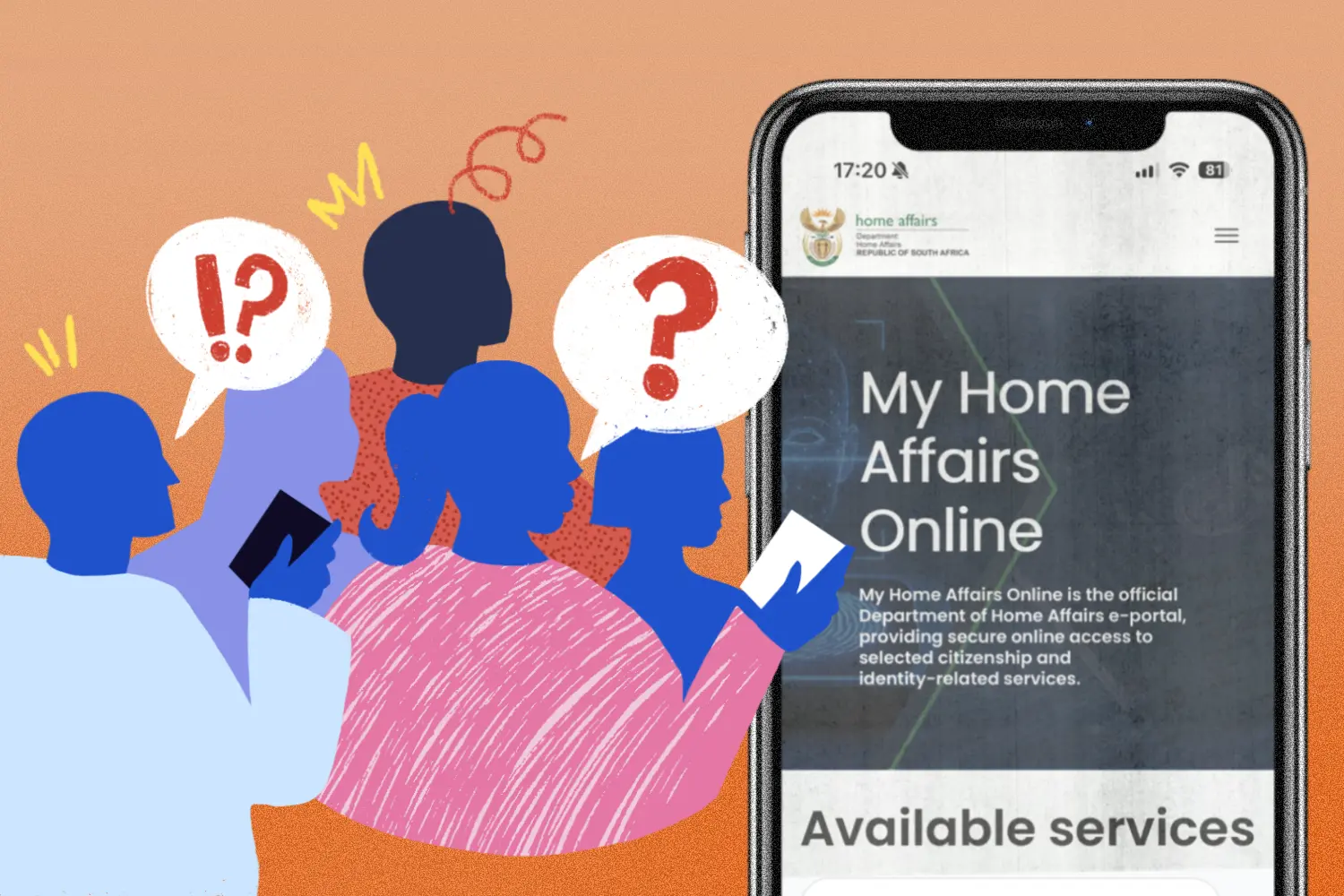
Home Affairs computer systems are especially hard to navigate and use. Illustration: Lisa Nelson
In the early 2000s websites ending gov.za were simple, well-designed and smooth to navigate. You could easily find who held what position and their contact information. There was reasonable consistency across the government websites.
Today, the state’s websites are a mess. Just a few examples:
In the past week we’ve reported how the state’s internet systems are plagued with vulnerabilities. This is almost certainly due to a combination of lack of maintenance and incompetence of those responsible for maintenance.
SITA, the State Information Technology Agency, which is responsible for government’s IT, is a troubled institution. It was established in April 1999 to “consolidate and coordinate the state’s IT resources in order to achieve cost savings through scale”. It has failed to do this.
Since its inception it has had about 25 CEOs (seven since 2019). It has damning audits year after year. These are typical phrases by the Auditor-General:
We also looked at a few annual reports of government departments. Here are some comments on SITA:
A 2022 government-commissioned analysis is also condemnatory, albeit very politely, of SITA.
SITA’s revenue over the past three years has been R7.4-billion, R7.6-billion and R8-billion. But this is just a fraction of the national and provincial government IT expenditure (about R97-billion from 2016/17 to 2020/2021, or about 5% of government expenditure). This is a huge amount of money and websites are a small portion of this.
When we questioned SITA about which government departments they’re providing services for, they hid behind confidentiality agreements. This is against public policy and legal precedents which favour transparency of government operations.
Last year Parliament’s Standing Committee on Public Accounts (SCOPA) was scathing: “SITA has for several years failed to achieve satisfactory audit outcomes or to adequately support various government departments, agencies and other public institutions. This has left them with a high number of vacancies, inadequate IT support, obsolete technology, faulty procurement processes and serious cyber security weaknesses.”
SCOPA’s chair, Songezo Zibi said: “It is unacceptable that at a time when information technology is so critical to financial controls, governance and operational effectiveness, the sole agency tasked with supporting government is failing so dismally and for so sustained a period.”
Until June 2025, government departments had to procure IT services through SITA, though judging by annual reports, this was not widely adhered to. Member of Parliament Tsholofelo Bodlani (DA) explained why this policy has changed: “For far too long, vital Government services, from Home Affairs to Police and Social Development, have continuously been ‘offline’, leading to massive backlogs, as SITA has not had the capacity to deliver for all its government clients. … new regulations will allow departments to compare service providers and make a business case, should they wish to deviate from SITA.”
But the problem is far from just SITA. As we showed here, the non-SITA part of the gov.za network has a higher ratio of security holes than the SITA one.
IT is a field in which the provider has a lot more technical understanding than the client. It makes it easy for the provider to deceive the client into over-paying and agreeing to unnecessary services. Clients often do not know how to assess the quality of the work done.
IT is also an easy field for crooks to make a lot of money quickly. SITA is mired in corruption findings and allegations. But it is not alone. The Sunday Times reported that an IT company paid for Ekurhuleni’s former city manager’s London shopping spree. It’s probably not a coincidence that we found that more than one in ten of the hosts on Ekurhuleni’s network have security vulnerabilities.
In our next article, we will make recommendations on how the government can improve its websites.
