5 December 2025
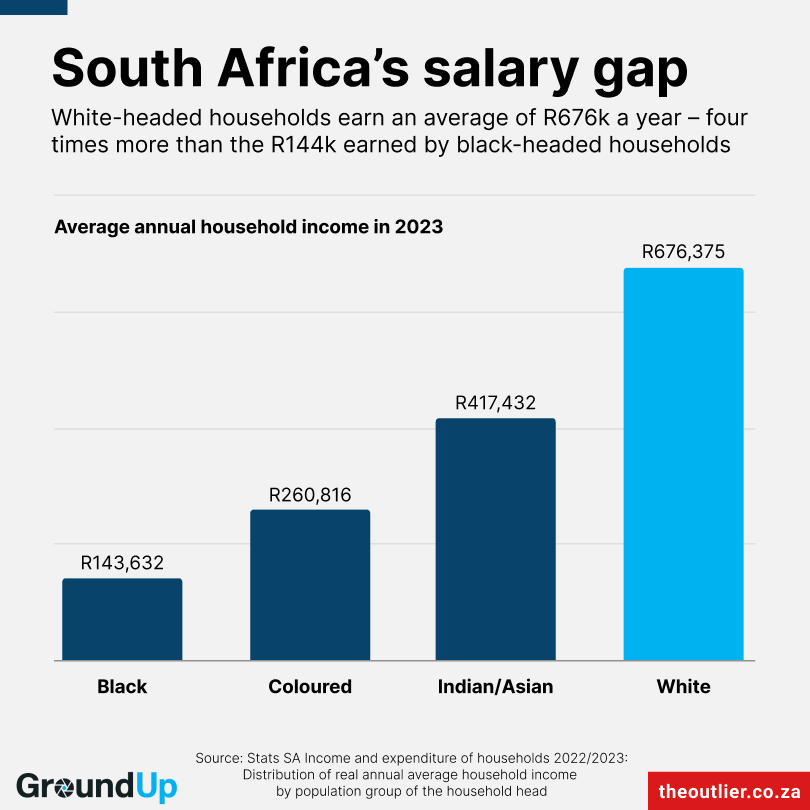
According to Stats SA, white-headed households in South Africa earned on average four times more than black-headed households in 2022/23. StatsSA defines a household head as the person recognised as such by the household — usually the main decision-maker, the owner or renter of the dwelling, or the main breadwinner. The racial groups displayed here are the same used by the apartheid government to segregate South Africans. South Africa’s democratic government and Statistics South Africa still use these classifications to affect and measure redress.
Debate, prompted largely by US President Donald Trump’s stance on South Africa, has raged over whether South Africa is legislatively discriminating against white people. See, on the one hand, the Race Law website, and on the other, “South Africa does not have 142 racist laws. Here’s what the claim gets wrong”.
As our graphs this week show, white people are doing very well in democratic South Africa. By nearly any measure of wealth and educational attainment, whites are doing better than any of the other apartheid-defined racial groups.
There is a possible exception, though: the lowest-earning 20% of white people are poorer than the lowest-earning 20% of black people, according to an analysis published in 2024. But this finding needs further research, as it could be because of the small sample size or a measurement error.
A question post-apartheid governments have to answer is: How do we grow the economy and create a more racially equal society? Anyone who thinks the answer to this question is simple, or that the question itself isn’t important, fails to understand South Africa’s political complexity. The government’s answer to this question has been a policy of affirmative action and black economic empowerment.
There are vehement criticisms to be made about South Africa’s anti-discrimination laws and black economic empowerment (BEE). BEE has created a massive bureaucracy and a dubious consulting industry that assists companies in navigating Byzantine laws. Whites are a declining portion of the civil service, which deprives the state of much-needed skills. Many BEE policies arguably benefit the elite at the expense of poorer people. But ignoring the picture that our graphs today paint hinders sensible debate.
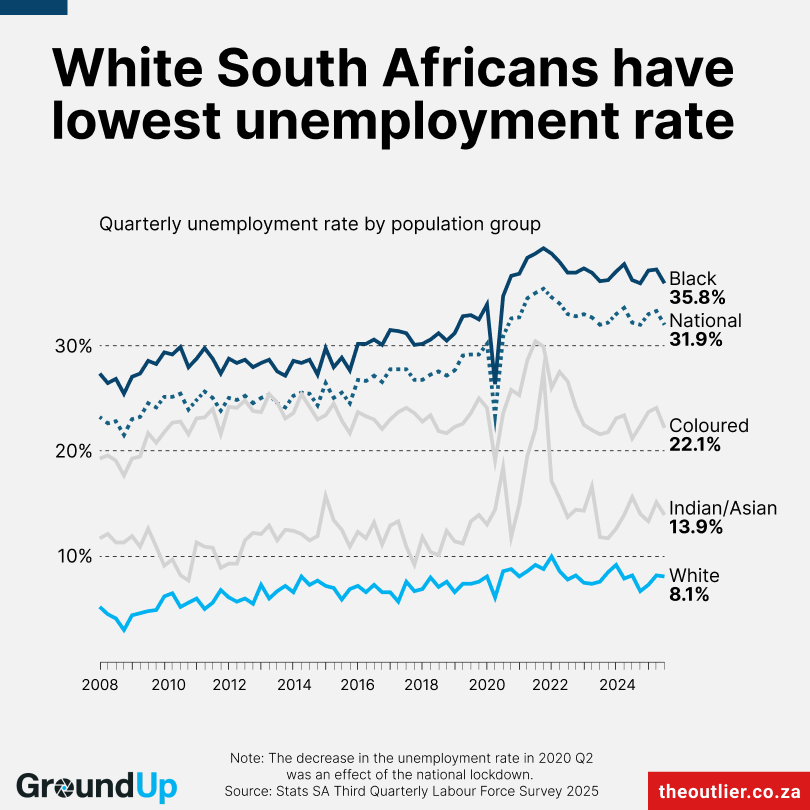
35.8% of black people in South Africa are unemployed, compared to 8.1% of white people, 13.9% of Indian/Asian people, and 22.1% of coloured people.
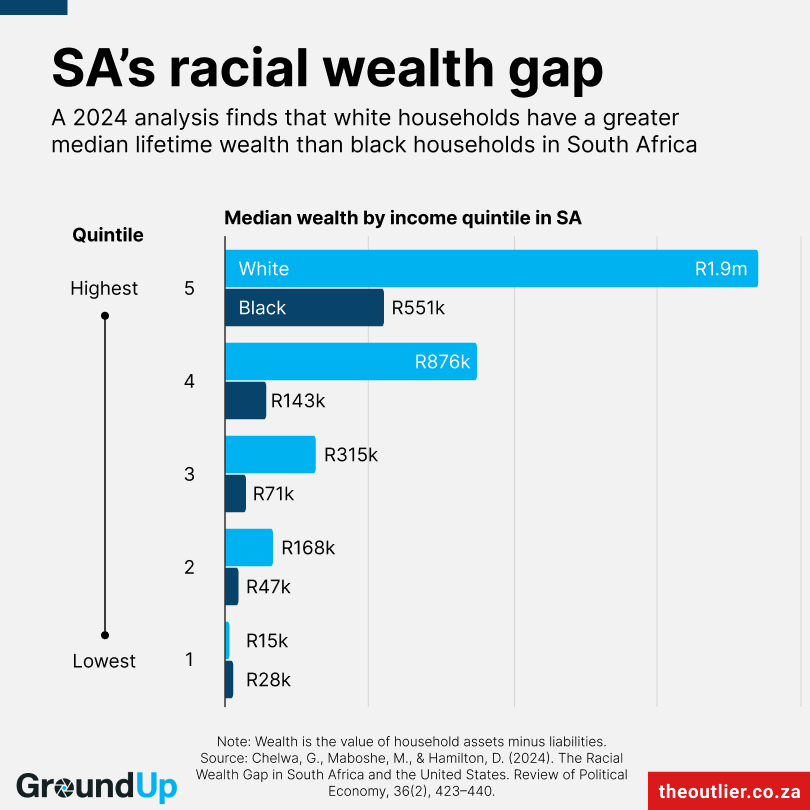
A 2024 analysis of the racial wealth gap in South Africa measured how income correlates with wealth. “Black” in this study refers to Black African people in the South African context. The highest-earning 20% of white South Africans have a median wealth (assets minus liabilities) of R1.9-million, while the highest-earning 20% of black South Africans have a median wealth of R551k. White people tend to be wealthier than black people in all the other income quintiles, except the very lowest: the 20% of the white population that earns the lowest are less wealthy than the lowest-earning 20% of black people. This finding requires further research: it could be driven by small sample sizes (which often is the case with white people in SA) and could be a result of measurement error (e.g. misreporting wealth).
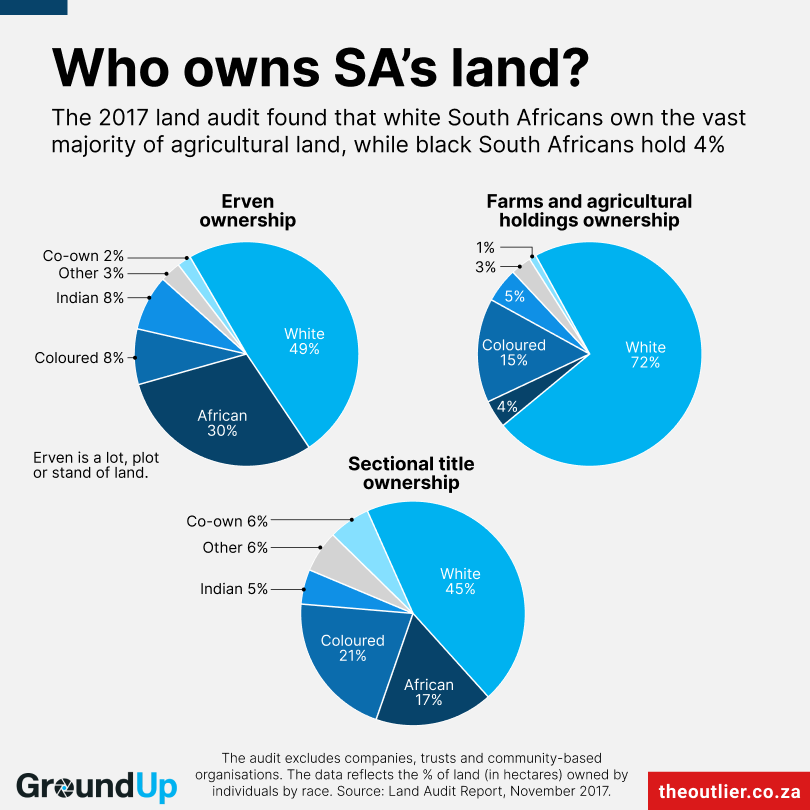
In 2017, 72% of privately-owned farms and agricultural holdings in South Africa were owned by white people. White people also owned more erven and sectional titles than any other racial group.
Charts produced by The Outlier in partnership with GroundUp