9 September 2026
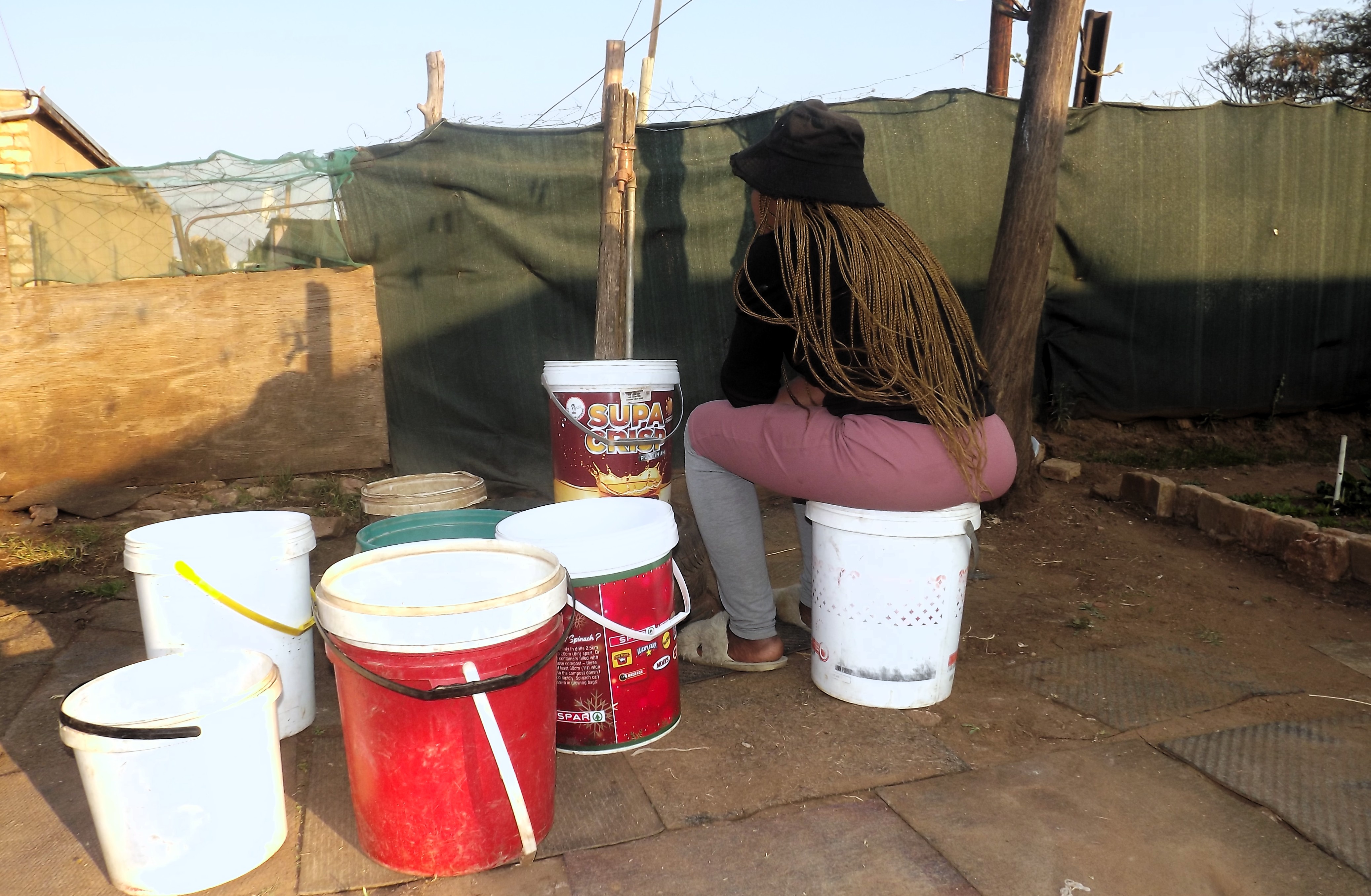
Hlengiwe Mtsweni sits with empty buckets at the dry tap in her yard in Thembalethu village, Mpumalanga. Photo: Warren Mabona.
“We sometimes spend the whole week without getting water from our taps,” said Hlengiwe Mtsweni, a resident of Thembalethu village in Mpumalanga’s Thembisile Hani Local Municipality. “I have to spend R300 every month buying water from people who sell it on our streets.”
Sphiwe Ntuli of Tweefontein G village said that they only get water once a week on Wednesdays for just two hours.
In 2021, the South African Human Rights Commission (SAHRC) found that the municipality was violating “residents’ right of access to basic water supply”.
In a high court case brought last year by the DA, municipal manager Dumisani Mahlangu admitted in a responding affidavit that “the volume and reliability of water supply has deteriorated”.
The ANC-led municipality does not have sufficient water sources of its own, so it contracts other municipalities and water boards to provide bulk water, including among others Rand Water, which has been supplying slightly more than its contracted 30 megalitres (ML) a day.
The 2024/25 annual report puts the municipality’s daily water demand at 99ML/day. According to Mahlangu’s affidavit, contracted bulk water sources are supposed to provide 51.6ML/day – not enough to meet the municipality’s demand. Worse, it only received 41.7ML a day on average from its bulk water sources, resulting in a daily shortfall of 57.3ML.
The City of Tshwane, contracted to supply 16.6ML/day, has only been supplying 0.35ML. The Dr JS Moroka Local Municipality, in Mpumalanga, meant to supply 5ML, has only been supplying 0.02ML.
In 2023, Thembisile Hani Municipality asked the SAHRC to intervene in a dispute resolution with the City of Tshwane. Mediation failed, and an intergovernmental dispute was formally launched on 13 October 2025.
Mahlangu said in his affidavit that “no response was received”, leading to the dispute being referred to Minister of Cooperative Governance and Traditional Affairs Velenkosini Hlabisa.
Tshwane spokesperson Lindela Mashigo confirmed to GroundUp that the City has not consistently been able to supply Thembisile Hani with water at the agreed level, because the Bronkhorstspruit Water Treatment Works (WTW) has been operating below capacity for years and experiences frequent breakdowns.
Mashigo said a contractor is being appointed to refurbish the works and restore its capacity.
GroundUp contacted Dr JS Moroka, but did not receive a response.
DA councillor Joseph Sibanyoni approached the Mpumalanga High Court in Middelburg to declare that the municipality had breached its constitutional duty to provide water, and to order it to submit a comprehensive water-delivery plan, including the status of its boreholes, tankers and other infrastructure, as well as a delivery schedule.
No court date has been set.
Sibanyoni alleged that most of the municipality’s 32 wards did not receive a consistent water supply, with residents relying on sporadic tankers, buying water or going without.
In its responding affidavit, the municipality claimed the court case was politically motivated ahead of the upcoming local government elections. Mahlangu acknowledged water challenges but denied that the municipality was violating the Constitution.
Mahlangu said that in addition to insufficient bulk water supply, other factors included ageing water infrastructure, theft and vandalism, increased demand due to population growth, and less water being pumped from existing sources.
Mahlangu said the municipality is focusing on bulk supply upgrades, reducing water losses and expanding borehole capacity.
The Bundu WTW is being upgraded. The Loskop Regional Bulk Water Scheme is expected to add 20ML a day by November 2027; it was supposed to be completed by end of 2024. Longer-term plans include additional supplies from Rand Water and Magalies Water.
Mahlangu said household access to potable water had expanded. The municipality had been repairing and expanding its borehole network. It had drilled 28 boreholes and deployed water storage tanks in affected communities.
But according to the municipality’s annual report, only 116 of its 214 boreholes are working. Thembisile Hani also has a critically low water billing collection rate, recovering less than 8% of billed water charges (collecting R9.1-million out of R114.7-million) in 2024/25.
The annual report notes that this poor revenue collection severely restricts the budget available to operate and maintain water infrastructure.
National Treasury says municipalities should spend at least 8% of the value of their infrastructure on repairs and maintenance each year. But in the last financial year, the municipality disclosed spending just R64-million (2.3%).
Both Tshwane and Dr JS Moroka municipalities have also underspent. Last year, Tshwane’s repair and maintenance spending was 2.7%, while Dr JS Moroka’s was 3.4%. Tshwane lost water worth R1.7-billion – about 39% of all the water it bought.
