22 May 2026
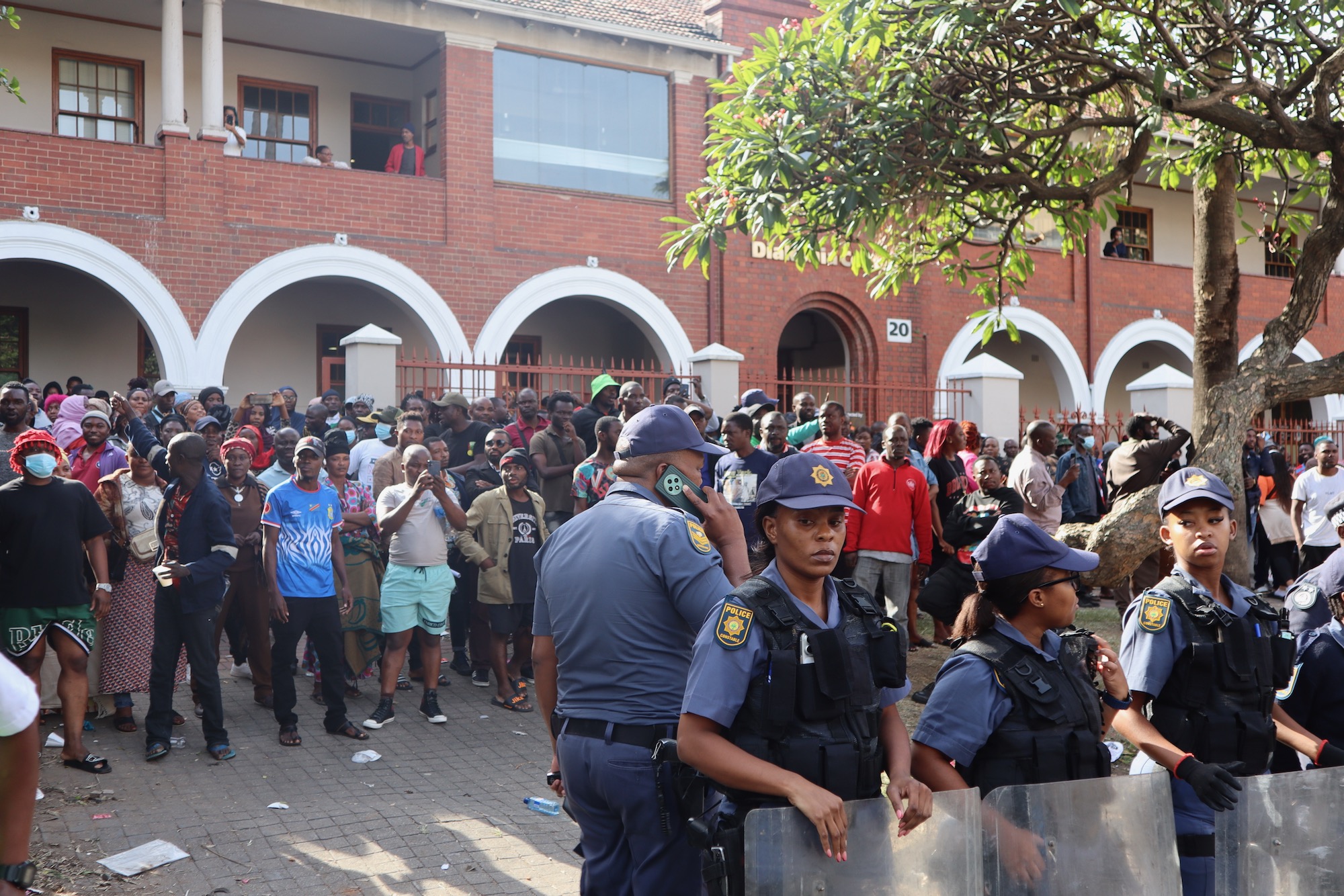
Displaced immigrants stand outside the Diakoni Centre behind a line of police officers protecting them. Photo:Joseph Bracken.
For five days a group of immigrants in Durban have been camping outside buildings, fearing for their safety if they return home.
At the start of the week they went to the Durban police station, where community leaders met with police officials. They requested protection from anti-immigrant groups that had forced them from their neighbourhoods.
The municipality had arranged two places for accommodation – the Elangeni Hotel for the men and a shelter on Mansel Road for the women. But they were turned away and had to camp outside the police station for the night.
The following day, the group was forcefully removed from outside the police station by SAPS officers using batons, tear gas, rubber bullets, and stun grenades, according to the Congolese Solidarity Campaign (CSC).
The group had now grown to about 300. They went to the Diakonia Centre to seek refuge. The centre houses multiple church groups and is also the office for shack dweller movement Abahlali baseMjondolo, which has taken a stand against xenophobic attacks in the past.
The group spent Tuesday and Wednesday camping outside the centre whilst representatives of Abahlali, refugee social services, community leaders, and human rights lawyers met.
“The outcome of the meeting was that all possible actions would be taken to ensure the safety of the refugees,” according to a CSC press release.
A meeting was held between refugee leaders and Home Affairs officials on Wednesday. It was agreed that the migrants and refugees would undergo a verification process at the Refugee Reception Centre on Moore Road the next day.
On Thursday, March and March members arrived outside the Diakonia Centre to protest. At about 2:30pm, the March and March members attempted to cross a police line to get to the immigrant group, but were stopped. SAPS officers had to use riot shields to push them back.
At about 4pm, municipal buses arrived to take the refugees and migrants to Home Affairs for verification. The buses were briefly blocked by March and March members.
Some of the people who were camping outside the centre were forcefully taken to the buses by SAPS and Metro officers after refusing to leave.
At Home Affairs, most of the people in the group were verified as documented, according to Raphael Bahebwa, president of the CSC. Only one person was found to be in the country illegally, he said.
Cyril Xaba, the eThekwini Mayor, addressed the group outside Home Affairs. He told them that most of the migrants had been verified as being legally in the country and could now go home.
Eric Jean Butoki, chairperson of the Southern Africa Refugee Organisations Forum (SAROF), told the mayor that they did not feel it was safe to return home, as the people who had threatened them did not care whether were documented or not.
Xaba said that it was now up to their leaders to find a safe space for them. “I’m sure you can make a plan as the leader. I leave that to you. That’s what leaders are there for,” he said.
Butoki expressed disappointment at the outcome.
A group of about 150 people are still camped outside Home Affairs.
Everyone we spoke to said they had been attacked and could not return to where they had been working as street vendors and roadside salon owners.
Junior Machiel, a refugee from the DRC, said that he was operating a salon in the city centre when a group destroyed his structure and took his equipment, before beating him with a sjambock.
“They didn’t even ask us for our documentation,” he said.
Aduwa Isa, who left the DRC in 2016 and also worked as a barber, said he was also attacked.
“Even my neighbours have threatened me not to come back; there is no place left for me in South Africa,” said Isa.
Hafesa Harerimana, a refugee from Burundi, said their situation had become so bad that her husband had fled South Africa with their son. She said she has been left destitute.
Vanessa Ndabwa, a refugee from the DRC, said she joined the camp outside the Diakonia Centre after she was attacked and told to leave her home.
Her husband has one kidney and requires medical care. “I can’t even take him to the hospital, because we are blocked from going in by people because we are foreigners.”
