20 February 2026
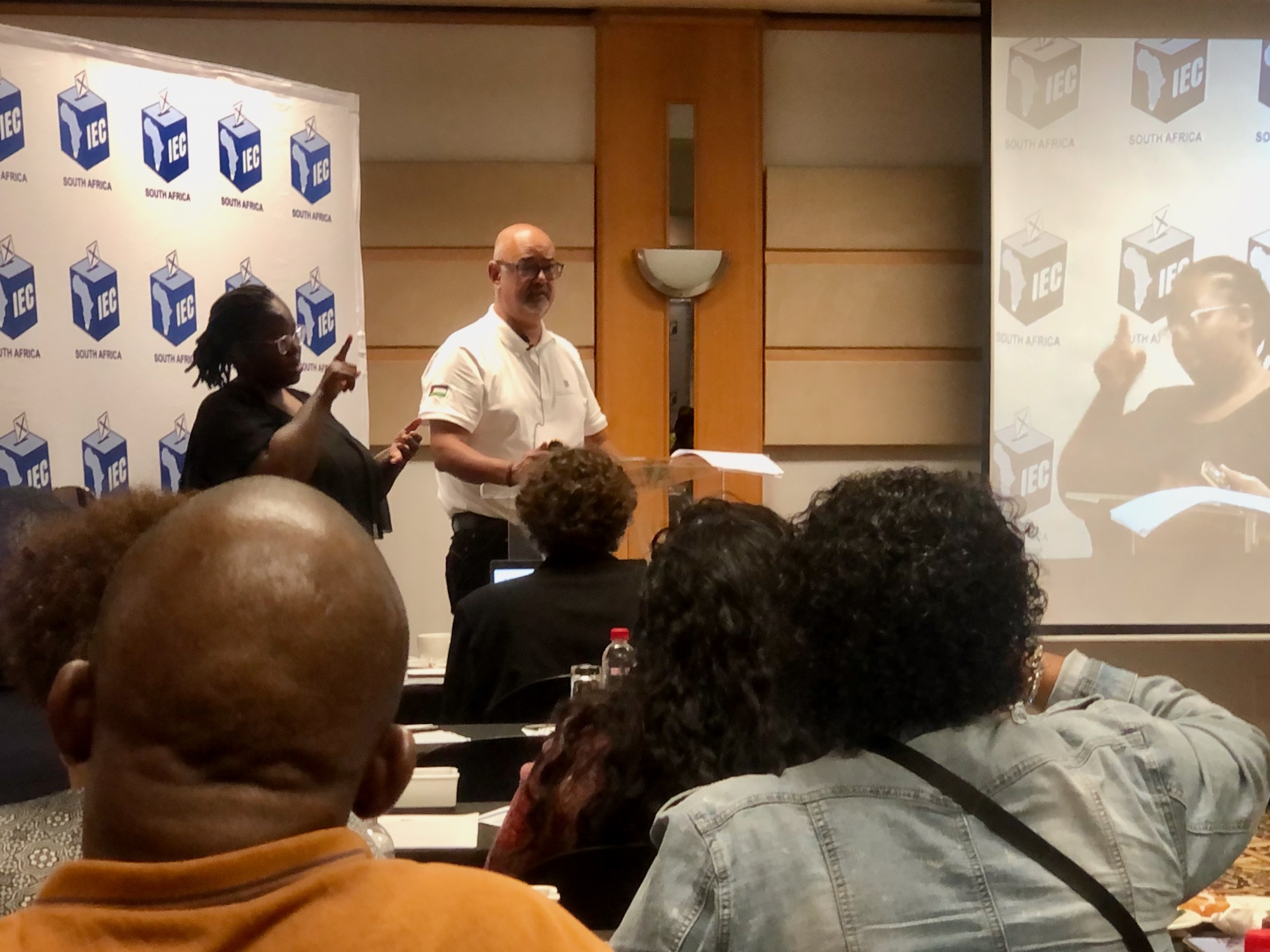
Michael Hendrickse, provincial electoral officer for the Western Cape, addressing an engagement in Cape Town hosted by the IEC for the disability sector. Photo: Mary-Anne Gontsana
In preparation for the upcoming local government elections, the Independent Electoral Commission (IEC) has instituted additional training for staff at voting stations to assist people with disabilities.
This is according to IEC commissioner Janet Love, speaking in Cape Town on Thursday to organisations representing people with disabilities.
She said some of the training was facilitated by people from the disability sector.
“We hope that it worked to some extent, but what we are clear about is that it has not solved the problem,” she said.
Love said some of the challenges related to “bigger societal issues”.
Michael Hendrickse, Western Cape electoral officer, revealed that in the 2024 elections there were 18,000 voting officials across the province but only 15 self-identified as having a disability.
“Surely that is something that needs to be looked at,” he said.
Later on, Anthony Ghillino, Western Cape Network on Disability chairperson and QuadPara Association of South Africa general manager, said, “I would be embarrassed to stand up there and say only 15 people out of 18,000 are people with disabilities who are employed by the IEC, whether they identify themselves or not. You guys need to recruit people with disabilities. I don’t know how you can represent a group that you don’t employ.”
Hendrickse said a municipal outreach coordinator had been appointed in each district to engage with the disability sector to address challenges.
He said there were many jobs, not only during election time, and everyone was welcome to apply via the e-recruit system.
A representative from the Cape Town Society for the Blind observed that inclusivity was being preached, but there was “no accessible format for the blind” and no braille version of the programme at the event.
Hendrickse apologised and said he would raise the issue with the national office.
Barbara Meyer, from Cape Mental Health, asked Hendrickse to explain the current situation for people with disabilities who wish to vote.
Hendrickse said a person with a disability may be assisted at the voting station by a person of their choice, who may accompany them in the voting booth.
“If you have no assistant, there is a presiding officer to assist you in the presence of two agents,” he explained.
Other services included braille templates and queue management.
In closing, Love said, “We see the idea of nothing about us without us as being a basis for a partnership … We are saying that many of the experiences, we don’t know enough about.”
“Our partnership with you is something we need and because of that we are saying please join us, let us work together, and make sure we are able to improve, learn and build what we need to build.”