19 December 2025
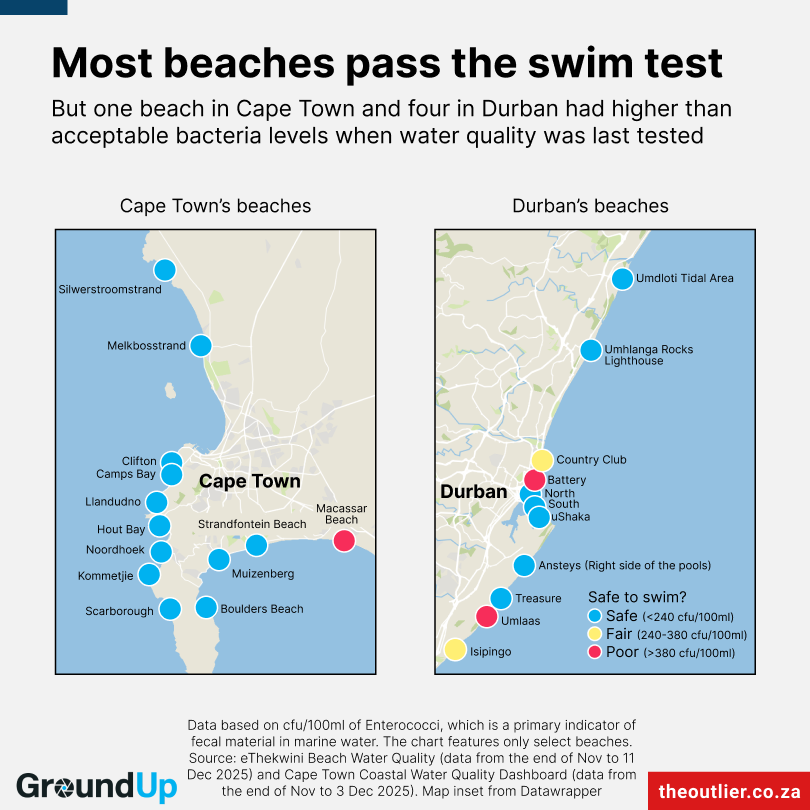
Cape Town and Durban are South Africa’s most popular beach destinations. Untreated sewage flowing into the ocean in both cities has led to beach closures in past years. In the most recent sample tests, unsafe levels of Enterococci (a primary indicator of faecal pollution) have been found at several beaches. But all beaches remain open.
In Cape Town, water at all but one beach had safe levels of Enterococci in the most recent samples taken between the end of November and 3 December. Macassar Beach, which lies at the mouth of the polluted Eerste River, had unsafe levels.
But the beach remains open. Daily Maverick reports City of Cape Town Mayco member for water and sanitation, Zahid Badroodien, as saying water quality has not been “consistently poor” at Macassar beach.
There are warning signs at beaches that have had poor water quality over the past 12 months. According to the Daily Maverick, these include: Lagoon Beach, Three Anchor Bay Beach, Barley Bay, Hout Bay Mariners Wharf, Hout Bay Chapmans Peak, Kalk Bay Harbour Beach, Sunrise Beach Parking Area, Ribbon Road Parking Area, Mnandi Beach, Monwabisi Beach, Macassar Beach and the Strand Pipe Surfing and Lifesaving Club areas.
The City advises against swimming in the ocean within 12 to 24 hours after heavy rainfall.
The most recent test results are available on the City’s water quality dashboard.
The reliability and transparency of eThekwini Municipality’s coastal water quality have been questioned recently. News reports of unsafe water quality at 15 of Durban’s beaches have been dismissed as fake news by the municipality.
Lists published on the municipality’s main website include only the most recent data on E. coli readings and not Enterococci, which the City of Cape Town uses and is seen as a more reliable indicator of sewage pollution than E. coli.
All of Durban’s beaches are safe based on the E. coli data, according to the municipality.
But another website on the municipality’s domain, which has the most recent Enterococci readings taken between the end of November and 11 December, shows a different picture. Two beaches had unsafe levels of Enterococci. Two had fair, and seven had very safe levels.
Average data on Durban’s beach water quality over the past 12 months is not available.
The municipality last week closed two beaches — Bronze Beach and Umhlanga Main Beach — as a precautionary measure after a sewage pump station failed.