10 February 2026
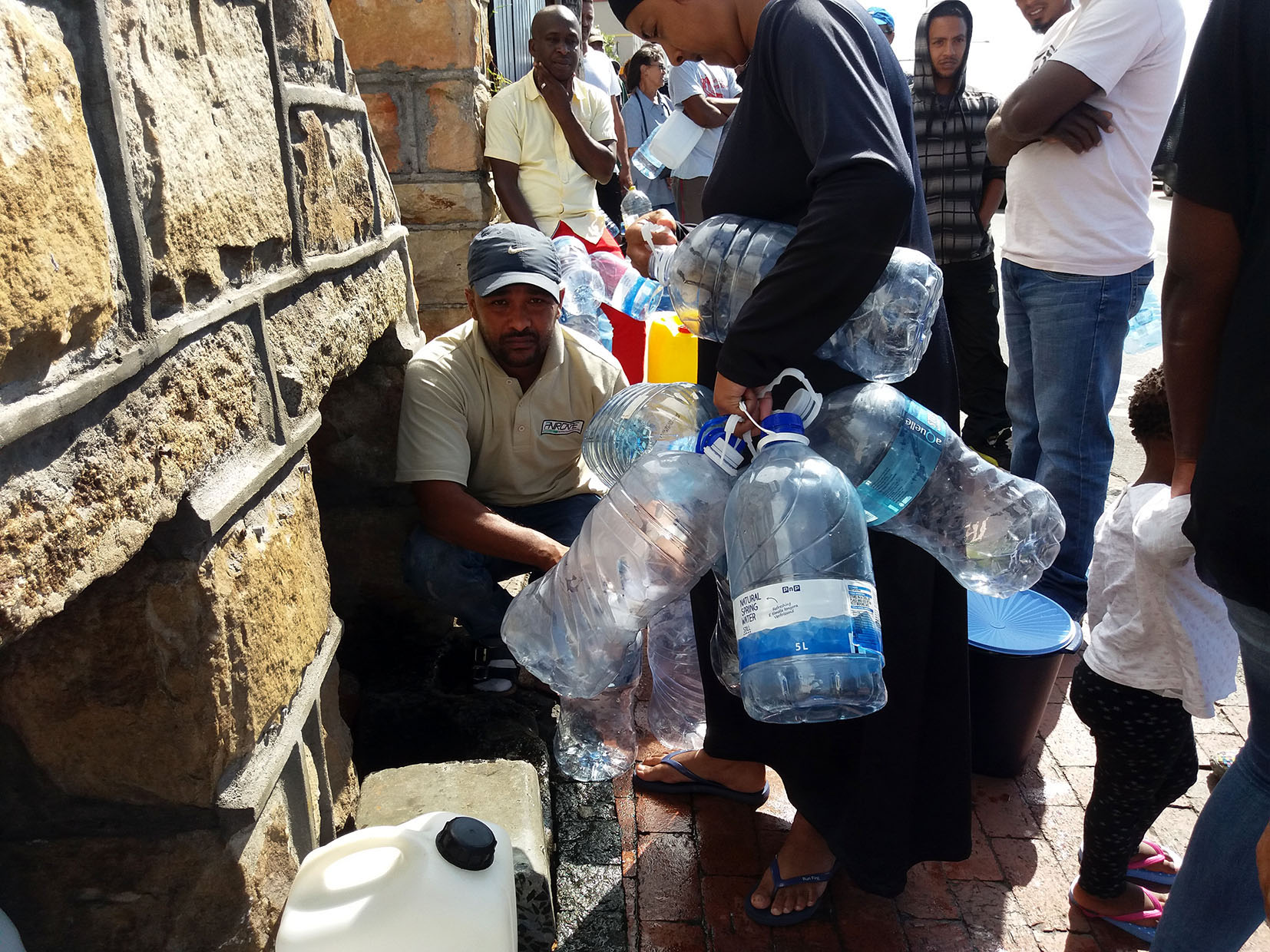
Capetonians queued to collect water from springs during the drought of 2017/18 in order to relieve pressure on the city supply dams. Figures of daily per-person water use suggest some water-saving habits have been retained. Archive photo: Steve Kretzmann
The level of dams supplying Cape Town with drinking water dropped to 59% this week as the dry summer season continues, spurring the municipality to “encourage residents” to use less water.
In a statement on 4 February, mayco member for water and sanitation Zahid Badroodien said there is “no immediate cause for concern about water security in Cape Town”, but it is our “collective responsibility” to use water wisely.
This followed a statement on 28 January: “While taps are not at risk of running dry at this stage, continued high water use could rapidly change the situation and result in restrictions.”
The municipality has set a target of 975-million litres of water use a day, but we are now using 1,073-million litres a day, stated Badroodien. That’s almost 100-million litres per day above the target.
Dr Kevin Winter, in an analysis published by GroundUp last week, stated that Capetonians are using 212 litres per person per day. He calculated this by dividing the total amount of water supplied by water treatment works to the water distribution network (1,060-million litres a day that week) by the estimated number of Cape Town residents (5-million).
Per capita consumption is way above “the world average” of between 120 and 160 litres per day, Winter wrote.
But a closer look at the numbers shows that the average water consumption per person per day in Cape Town is not 212 litres.
Not all the water supplied from water treatment works is used by residents. It includes water for industrial and commercial use, as well as the water losses from leaks in the city’s reticulation network and from the water treatment process itself, which involves backwashing filters.
Industrial water use accounts for 3.5% of water use, while commercial use is at 12.5%, according to the municipality. Excluding flats and group housing, commercial use (shopping malls, business parks etc.) comes down to 11.8%.
Water losses (through leaks, illegal connections, and during treatment etc.) account for 22.7% of the water use, the municipality says. This is below the maximum acceptable limit of 30%.
If we take these percentages off the latest usage of 1,073-million litres per day, the sums are as follows:
1,073-million less industrial use of 38-million, less commercial use of 127-million, less water losses of 244-million leaves us with 664-million litres being used by the residential sector per day.
When that is divided by the approximately 5-million residents (the municipality’s latest mid-year estimate is a bit over 5-million), the answer is about 133 litres per person per day.
This is well within the purported global average of 120 to 160 litres per day. However, it is very difficult to calculate a world average for the amount of water used per person per day, an effort confirmed by fact-checking organisation Africa Check. The national government has claimed that the average per person use in South Africa is 173 litres per day, but the methodology to calculate this is not known.
Given that we are in the height of summer, the low residential water consumption suggests Capetonians have retained at least some of the water-saving habits acquired during the drought of 2017 and 2018.
Our calculation also does not take into account the water use by visitors to Cape Town, of which the municipality says there were 11.1-million during 2025. The majority of those visitors are here during the dry summer months.
If each visitor was using a conservative 100 litres per day (it is estimated the tourism sector in South Africa uses 300 litres per person per day) and stayed in the city for five days on average, their use would amount to more than 15-million litres per day. This amount is higher in the summer months and lower in the winter months.
There is no argument that we need to conserve water in Cape Town, particularly with climate change models predicting temperatures in the Western Cape will increase while rainfall decreases.
The municipality can be commended for seeking alternative water sources such as desalination, and water re-use in particular (although there are serious concerns over the municipality’s plan to have a private, for-profit company responsible for the implementation and operation of their water re-use scheme).
However, of the 24 wastewater treatment works (sewage treatment works) the municipality operates, 16 of them were releasing treated effluent within the Department of Water and Sanitation’s categories of ‘poor’ and ‘bad’.
Among the failing wastewater treatment works are the large ones situated in or near industrial or agricultural areas. These include the wastewater treatment works in Athlone, Borcherd’s Quarry, Potsdam, Bellville, and Cape Flats.
If these treat sewage properly, the treated effluent can replace potable water used for irrigation of sports fields, parks, golf courses, and even residential gardens. Some industries can also use treated effluent instead of potable water. The municipality states it is doing this, but the practice becomes untenable when the effluent doesn’t meet minimum standards, as is the case with more than half of them.
GroundUp has previously reported on Astron refinery’s inability to use water from the municipality’s Potsdam sewage treatment works due to the effluent not meeting minimum standards. This led to them having to use up to 5.9-million litres of potable water per day to cool distilled crude oil, and for steam generation to drive pumps and compressors. That was in 2019, but the Potsdam sewage treatment plant is still failing to treat its effluent to minimum standards, with sources saying the refinery is still struggling to use the effluent from Potsdam.
There is a line supplying effluent from Potsdam to Woodbridge Island for watering the gardens of 340 homes in a sectional title scheme. This infrastructure should be expanded as much as possible to residential areas across the city so that residents do not have to use potable water to keep plants alive.
But Woodbridge Island resident and member of the municipality’s section 80 committee on water quality in wetlands, Caroline Marx, said there has been no irrigation water from Potsdam for three months. “They say there’s a break in the line, forcing the usage of potable water to keep at least some plants alive,” said Marx.
A break in a line that helps to save potable water should not take three months to repair. Being able to use Potsdam’s effluent also depends on the quality of the effluent, which had “high level failures” in 41% of all 2,290 sample analyses of effluent quality, according to the DWS Integrated Regulatory Information System.
Residents should be commended for their conservative water use and urged to keep it up, and the municipality should make a greater effort to supply usable non-potable water where applicable to stave off future water restrictions.