20 May 2026
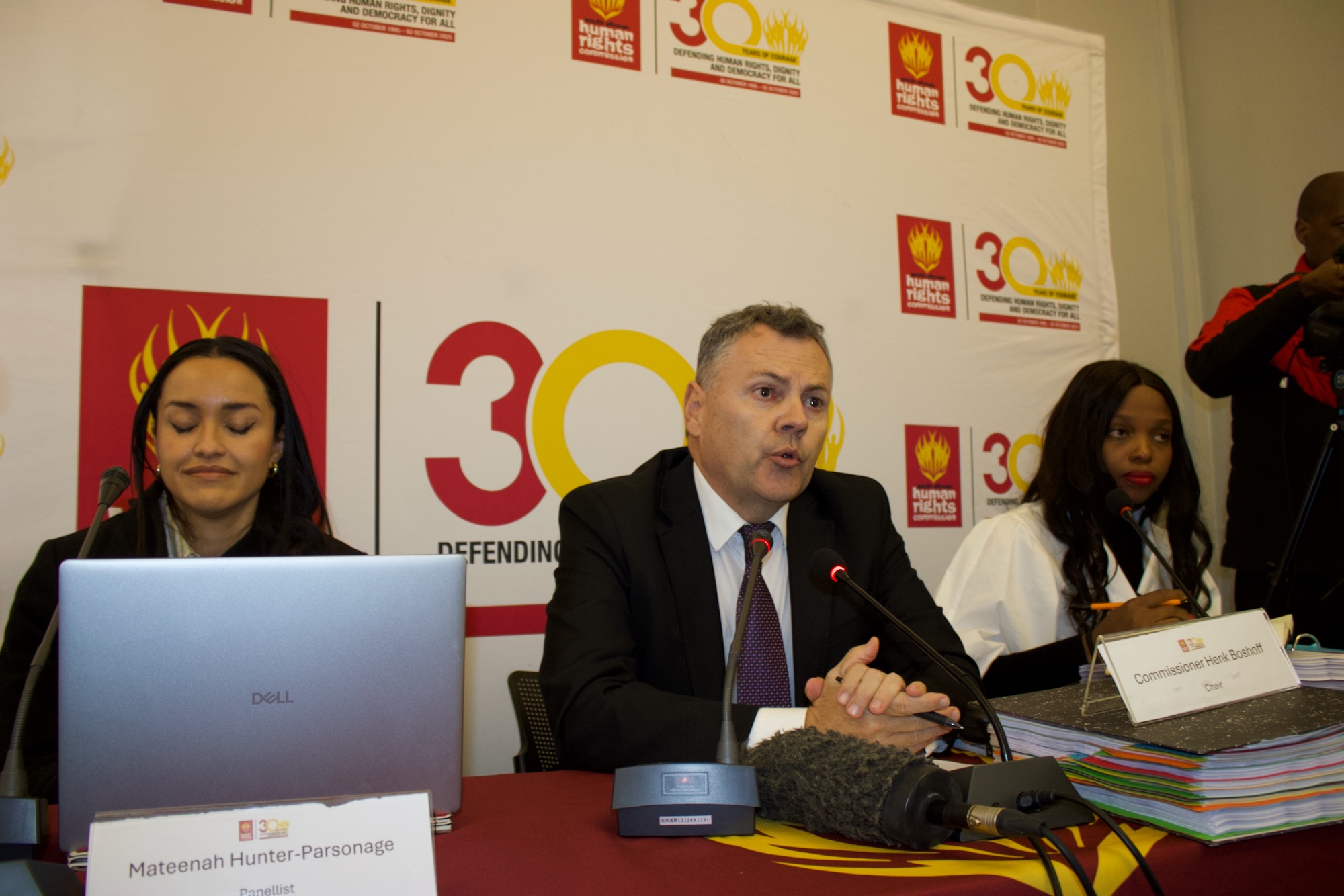
South African Human Rights Commission commissioner Henk Boshoff (centre) sharply criticised the failure of Gauteng’s municipalities to provide clean water and effective sanitation systems. He was joined on the panel by Mateenah Hunter-Parsonage (left) and Khululiwe Sithole (right). Photo: Seth Thorne
Gauteng’s municipalities are under scrutiny at a South African Human Rights Commission (SAHRC) investigative inquiry into the province’s water crisis this week.
Opening the inquiry on Tuesday, Commissioner Henk Boshoff pointed to water billing failures as “a symptom of an uncaring municipality” and said that some municipalities were showing “zero respect for authority” by failing to implement court orders compelling them to supply water.
The three-day inquiry is being held at Constitution Hill in Johannesburg.
Boshoff, who was joined on the panel by Mateenah Hunter-Parsonage and Khululiwe Sithole, promised that the commission’s report would lead to action and “is not going to gather dust”.
He said that while democratic South Africa has made progress in expanding access to water, there was still deep inequality and many residents struggled daily to access services.
Boshoff expressed concern over the growing reliance on private water tankers, describing the system as “nonsense” and arguing that municipal collapse had turned emergency water supply into an exploitative business. He noted that the City of Johannesburg spent R165-million on water tankers during the 2023/24 financial year.
Andries Sekgetho, from the Office of the Auditor-General, presented a forensic overview of Gauteng’s deteriorating water systems. He told the panel that most municipalities were moving in the wrong direction.
Metros are losing more than 30% of their water through leaks and illegal connections, while losses in Rand West and Emfuleni have reached 60%, said Sekgetho.
Most municipalities are under budgeting for maintenance and capital expenditure, resulting in reactive repairs instead of long-term infrastructure planning.
Sekgetho said the Auditor-General has found material irregularities with regard to wastewater treatment plants discharging raw effluent into rivers and other water sources.
He criticised the widespread lack of accountability in local government, saying municipalities often failed to act against contractors and officials linked to failed or delayed water projects.
Several civil society organisations made submissions to the panel.
“The Gauteng water crisis is not simply a story about drought, bulk supply constraints, or too little water in the system,” said Dr Ferrial Adam, executive director of WaterCAN.
“It is a systemic human rights crisis that is fed by governance failure, infrastructure neglect, poor to no financial controls, corruption and very weak transparency.”
Charice Rocha, of the Lammermoor Residents Landowners Association, said the systemic collapse of water governance has severely eroded public trust in the authorities responsible for water and sanitation services.
Trevor Brough, of the Cradle of Humankind World Heritage Association, warned that farmers are increasingly being forced to irrigate their crops with sewage-contaminated water. The Percy Stewart Wastewater Treatment Works, for example, is heavily polluting the Crocodile River and Hartbeespoort Dam, he said.
Sewage contamination poses risks for food security, tourism, and public health, he said.
“Wastewater treatment works in the province are so dysfunctional that wetlands are being wiped out and rivers are facing disaster,” said Mariette Liefferink of the Federation for a Sustainable Environment.
Zintle Tyuku of amandla.mobi emphasised the human impact. Residents in informal settlements are going for months and even years without water. Women and children in particular, who collect water far from home, are at risk of being robbed and raped, she said.
“No amount of protesting works. Promises are made each time, but never met,” said Tyuku.
Communities in Ekurhuleni have endured water outages lasting months on end, said David Hutch Barr of the Primrose Ratepayers Association. Communication from the government is inadequate.
“Access to water has become hinged on ability to pay for alternative solutions, deepening inequality,” said Barr.
Riyaan Salie, from the Local Development and Economic Civil Association, said he had personally experienced water shortages in Eldorado Park.
The crisis had created a lucrative market for private water tankers, he said. This could have been avoided through proper infrastructure maintenance.
Gauteng provincial government spokesperson Elijah Mhlanga told GroundUp that the inquiry’s structured format allowed people to engage constructively, in contrast to the anger displayed during service delivery protests.
He said the provincial government was listening carefully to the submissions and would consider them as part of an ongoing review process.
He said that while the province has an oversight role, the responsibility for resolving the crisis rested across all spheres of government.
“No one should push the responsibility onto others,” he said.
On Wednesday and Thursday, the SAHRC is expected to hear submissions from municipalities and the provincial and national governments.
