14 August 2026
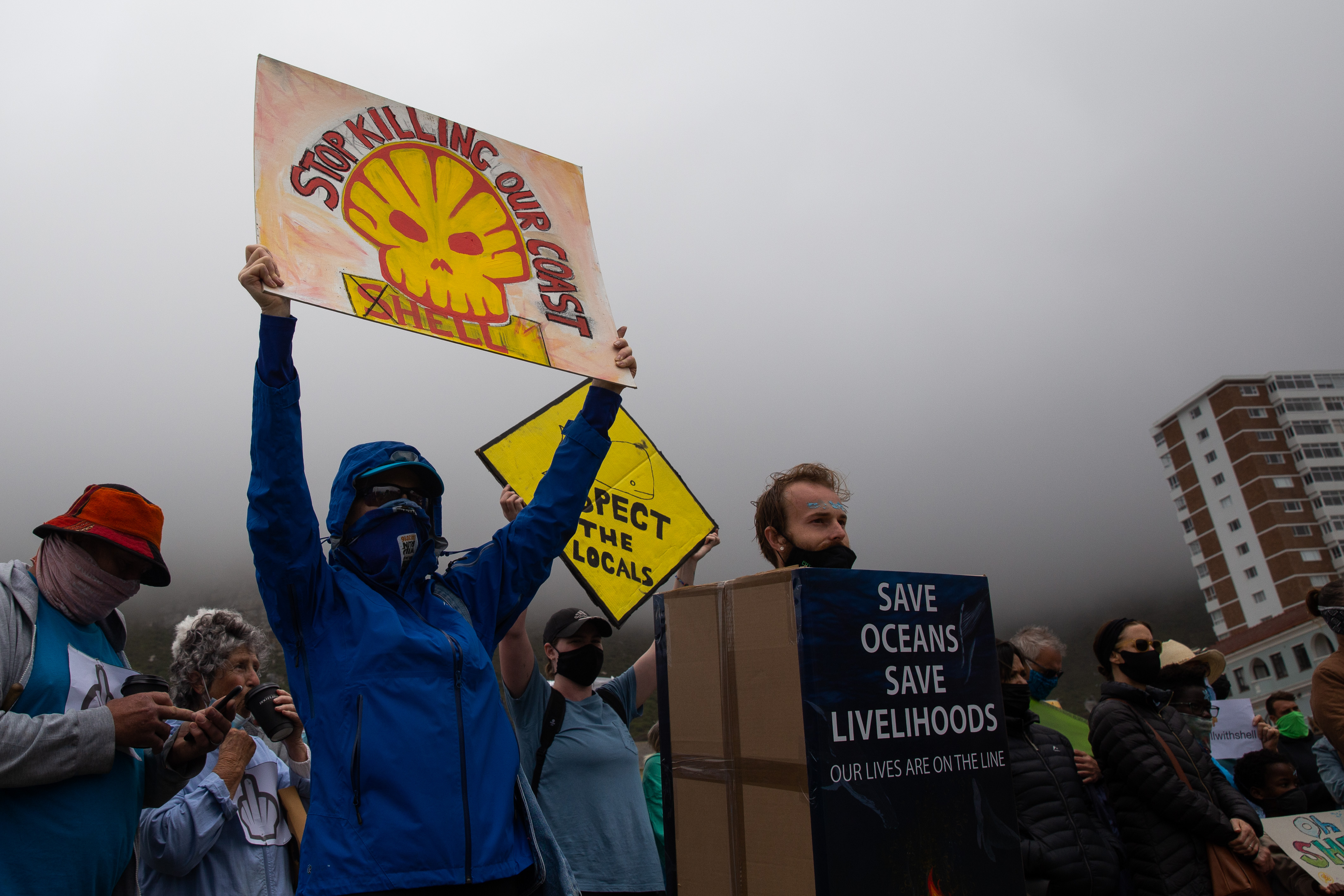
In December 2021, hundreds of people protested in Muizenberg, Cape Town, against Shell’s planned seismic survey to explore oil and gas deposits off the Eastern Cape’s Wild Coast. Archive photo: Ashraf Hendricks
Environmental justice activists and some Wild Coast communities were victorious in the Constitutional Court with a ruling that finally stops Shell and Impact Africa’s right to seismic exploration off that coast.
The exploration right, granted to Impact Africa by the Department of Mineral Resources in 2014 and transferred in half to Shell in 2021, is now unlawful and set aside in a majority judgment by the apex court, with no opportunity to renew it.
The court overturned a previous ruling by the Supreme Court of Appeal (SCA) that gave the oil companies one last opportunity to renew the licence, during which, they and the minister claimed, the defects in the award of the right – the lack of meaningful consultation with communities – could be cured.
In the majority ruling, handed down by Justice Jody Kollapen on Friday, the court said this was not a just and equitable order because the communities’ rights would not be vindicated.
The matter has been before the courts since December 2021 when the communities and activists secured an interdict, stopping offshore seismic surveys.
Seismic surveys are carried out by towing airguns that fire pressurised air towards the seabed, generating soundwaves which are used to image and detect the presence of oil and gas deposits.
The communities and activists alleged – and in September 2022, the Makhanda High Court ruled – that they were not properly consulted and the survey was a threat to marine life, livelihoods, and cultural and spiritual practices.
The high court ruled that the exploration right was granted unlawfully and the potential financial loss to the oil companies did not outweigh the constitutional rights of the affected communities.
Shell, Impact Africa and the minister took this ruling on appeal to the SCA, which confirmed that the exploration right was granted unlawfully but “suspended” this pending a determination of the application submitted on 21 July 2023 to renew the right for a third time.
The SCA held that the high court had failed to weigh factors including the R1.1-billion the companies had spent since 2012.
In the apex court, the communities and activists argued that the order was not lawful, that the right had been set aside and did not legally exist, so no renewal was possible.
They further argued that their rights could not and would not be vindicated during the renewal process, and could not cure the minister’s failure to consider climate change and legal prescripts when the right was first granted.
The majority agreed.
Kollapen said if the court were to make an order allowing consultation in the renewal stage, it would set a precedent that a flawed consultation process can later be “cured”. It would encourage future applicants to bypass proper consultation.
“… a just and equitable remedy must consider the public good and the rule of law, vindicate the rights of the aggrieved party and be fair to all the parties …”
He said consultation was not merely about an opportunity to express a view or influence an outcome.
“On a more fundamental level, it is a process which affirms human dignity by affording a seat at the table to those whose lives are impacted by decisions.”
“In the context of extractive industries, the enquiry cannot be reduced to a formal balancing exercise that treats cultural, religious, spiritual and environmental concerns as merely competing interests against economic development.”
Justice Kollapen said the extent and seriousness of the breach in this case was profound.
“To tell communities more than a decade after the fact, that they may now be consulted is not curative. It tells them that the violation of their rights was not a matter of substance but rather a matter of process.”
He said the company respondents were not “innocent”. They had taken no steps to engage with the broader affected communities as was required of them.
In a minority ruling, Justice Owen Rogers, with Justice Katharine Savage concurring, said that Shell could not be blamed for this and Impact Africa’s conduct was “not so egregious that the door should be closed to the possibility of the grant of its licence”.
There was no reason to “make light” of the companies’ expenditure of R1.1-billion.
The simplest remedy, they said, would be to require the process of consultation to run afresh.
Lucien Limacher, from Natural Justice, said, “This ruling affirms that Section 24 of our Constitution – the right to an environment that is not harmful to health or wellbeing – is not a paper promise. It is enforceable, and it applies even against the most powerful corporate interests.”
He said the judgment “sets a precedent well beyond South Africa” and “tells governments and companies alike that meaningful consultation with affected communities is not optional”.
