
16 April 2026
A street in Slovo Park. Archive photo: Chris Gilili
Little has changed in Slovo Park in the decade since a High Court judgement ordered the City of Johannesburg to upgrade the informal settlement.
“All we are asking for is dignity,” said Lerato Marole, chairperson of the Slovo Park Community Development Forum (SPCDF).
“I’m sure that no community member from Slovo would go to hell when they die. They have already been to hell,” said Marole.
Marole made these remarks in Braamfontein on Wednesday during a panel discussion assessing the City’s failure to deliver housing, flushing toilets and tap water to the people of Slovo Park.
Established in 1991, Slovo Park has 3,700 households and is home to over 10,000 people. After more than two decades of unmet development promises, the SPCDF, represented by the Socio-Economic Rights Institute of South Africa (SERI), successfully litigated to compel the City to implement the Upgrading of Informal Settlements Programme (UISP). At the time, the City had proposed evicting residents and relocating them to a planned development known as Unaville.
Nomzamo Zondo, SERI executive director, said despite the legal clarity handed down in the judgment, the last ten years have been defined by bureaucratic hurdles and unkept promises.
Professor Marie Huchzermeyer, an informal settlements expert from Wits University, has partnered with the community for years. She pointed to the lack of “institutional stability” in the City. She said the City also often appointed consultants with “no understanding” of the UISP.
“The City needs to build its own capacity,” said Huchzermeyer.
Phakamani Mpanza, advisor to human settlements mayco member Mlungisi Mabaso, acknowledged that the 2016 judgment was a “moral directive”.
He blamed “bureaucratic bottlenecks” and conceded that the City had “little to show for the ten years”.
He said over 3,700 households had now been formally profiled and that geotechnical and socio-economic studies were completed.
Community members attending the event pressed the office of the MMC to act with urgency and called for in-house community stakeholder forums with a direct line to the political leadership.
“Nothing for us, without us,” said Marole.
More on the long journey of the community can be found on the newly launched Slovo Park Digital Archive.
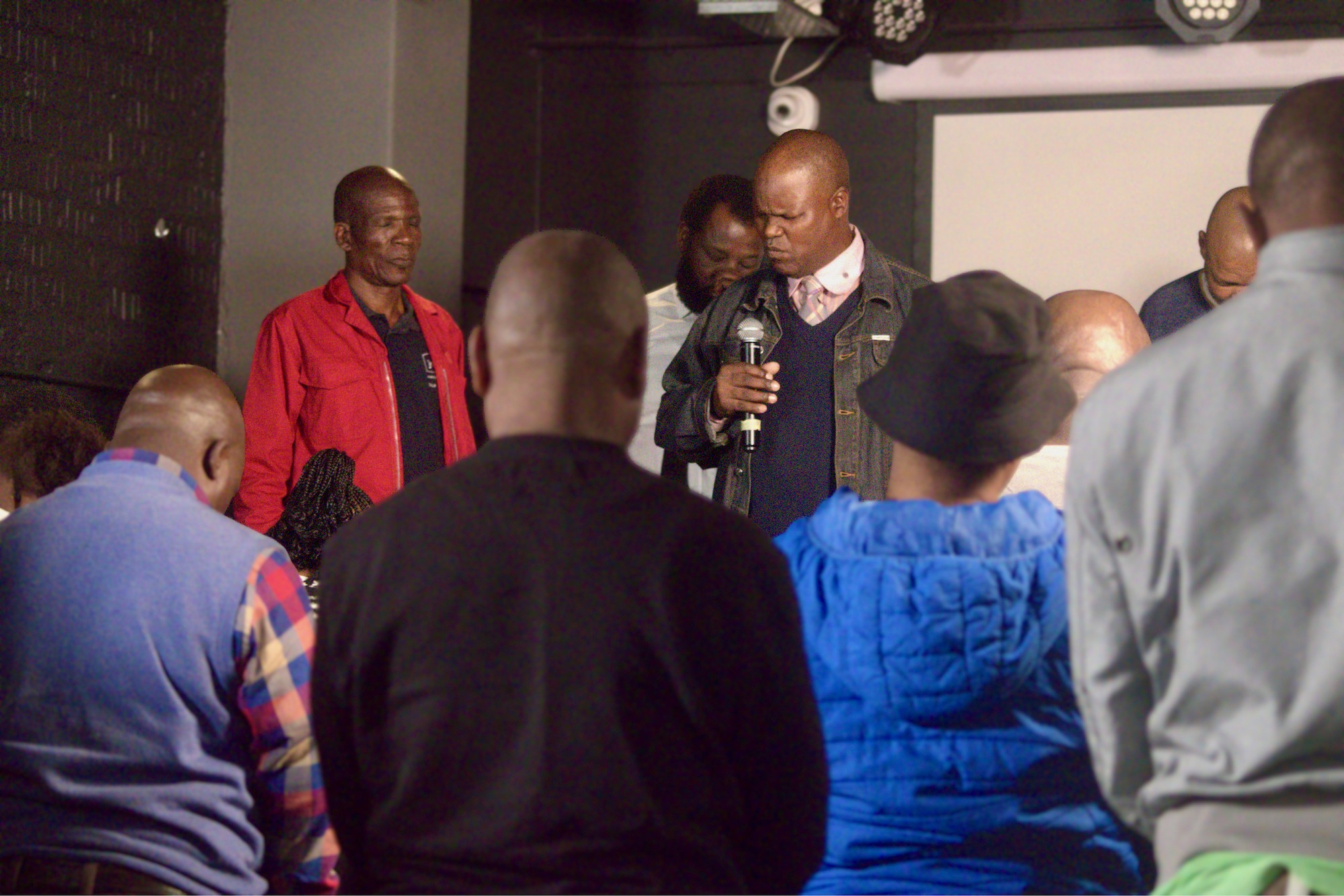
Archbishop Jeffrey Namusi opens a dialogue on the City of Johannesburg’s failure to implement a court order made ten years ago to upgrade Slovo Park with a prayer.
