5 October 2026
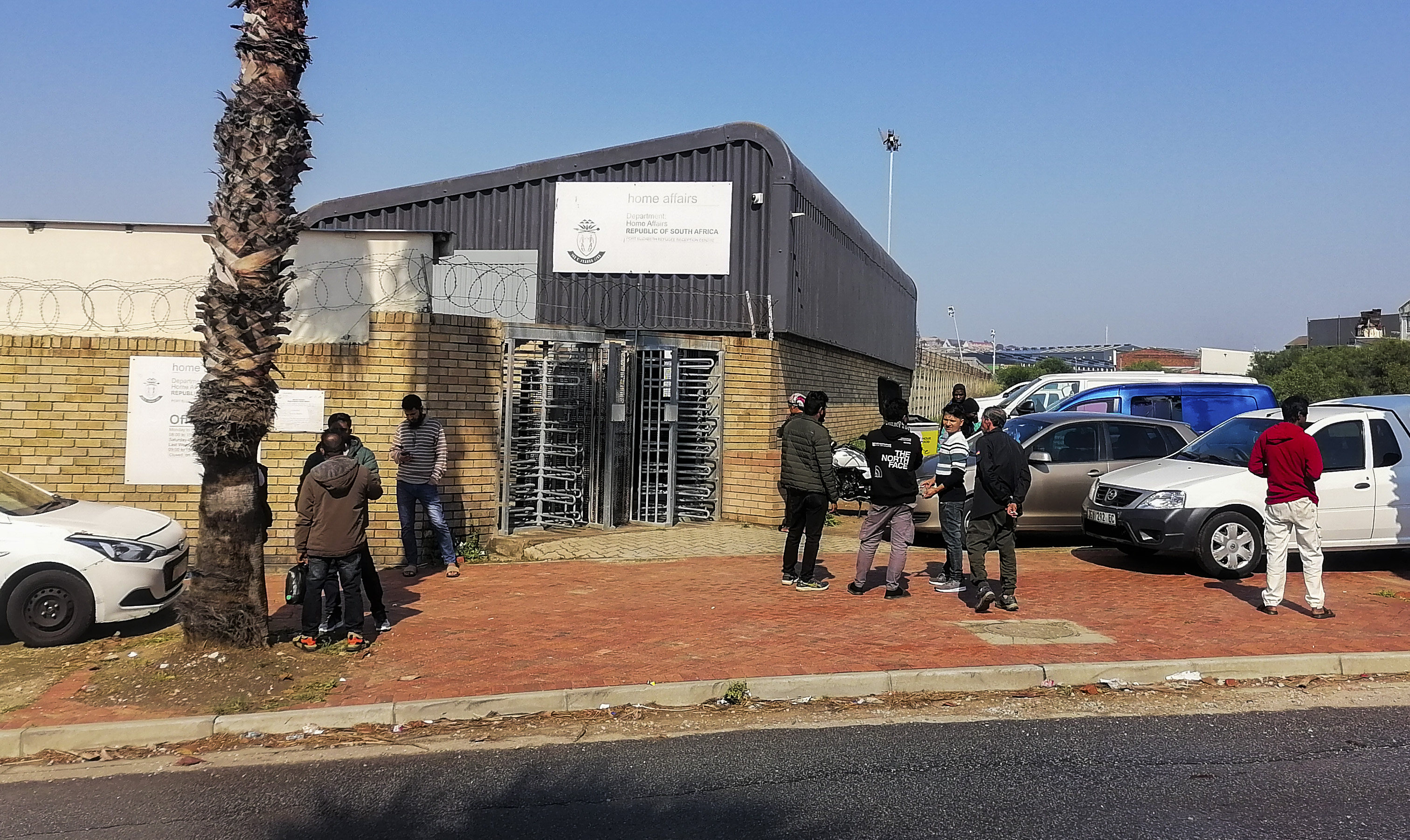
The Gqeberha Refugee Reception Office has reopened for new applicants, following a Home Affairs circular on 28 September. Photo: Joseph Chirume
For the first time in years, all asylum seekers, including people who entered South Africa unlawfully or have no visa, are being given access to the asylum system.
A Home Affairs circular on 28 September states that Refugee Reception Offices must accept applications from every new applicant.
From March 2020 to May 2022, Refugee Reception Offices were closed because of covid and took no new applications. Amendments to the Refugees Act, in force since January 2020, allowed Home Affairs to shut people out of the system before anyone looked at their claims.
People who had not entered the country through an official port of entry or did not report to a refugee office within five days were excluded unless they had “compelling reasons”. Those without an asylum transit visa had to show “good cause” for entering unlawfully before they could apply.
Only 91 transit visas were issued between April 2022 and March 2024.
The Scalabrini Centre of Cape Town, represented by Lawyers for Human Rights, challenged the provisions. It told the Constitutional Court that “hundreds of thousands of people” were affected.
On 7 July, the Constitutional Court confirmed a 2025 Western Cape High Court ruling striking down the provisions. The court found the amendments to the Refugees Act could see people sent back to danger without anyone deciding whether they were refugees, which is against international law.
GroundUp visited the Gqeberha Refugee Reception Office on Monday morning. We met a Bangladeshi national who lives in Jeffreys Bay. He had been given an appointment to return on 24 November. He said there were about 50 applicants inside.
A Home Affairs official told us anonymously that applicants should come early and should bring proof of identification showing their origins, or a letter from human rights lawyers. This is at odds with the circular, which bars officials from refusing an application because of “the absence of documentation”.
Tibebu Solomon, leader of the Ethiopian and Eritrean community in the Eastern Cape, led a protest by about 400 asylum seekers outside the Gqeberha office on 9 September. Most of the protesters were from Ethiopia and Eritrea. They gave Home Affairs 14 days to reopen the offices to new applicants.
Solomon said it was not yet time to celebrate.
“It is promising to see the department has responded and that our concerns have been acknowledged. For us, however, the response is not yet a victory. A real victory would be when asylum seekers are given fair access to the asylum system, their applications are properly considered and decisions are made according to the law and the individual circumstances of each applicant. We hope the department’s response will lead to practical action and not only a written statement.”
He said there was a possibility that applications could be processed too quickly, without giving applicants a proper opportunity to explain their circumstances.
James Chapman of Scalabrini said they were pleased that the department had finally acted on the Constitutional Court judgment.
“We’re hopeful there will be a smooth processing of new applicants. I’m optimistic that the offices will not be overwhelmed. I’d hope the department has put systems in place to manage the numbers, but we have to wait and see. If they’re not able to cope with the numbers, we will engage the department to ensure they manage the process, but I am hopeful they will be able to handle it.”
He also hoped the department has improved its refugee status determination process, given its history of high rejection rates. “I’m worried and wary that you may find people even from very clear refugee situations being rejected,” he said.
In 2017, only 479 applicants without family links in South Africa were granted refugee status at their first interview, while 25,713 were rejected, according to department figures analysed by the Helen Suzman Foundation.
In May, the Refugee Appeals Authority told Parliament it had a backlog of about 161,000 cases.
Linton Harmse, director of the Nelson Mandela University Refugee Rights Centre, was one of the organisers of the 9 September protest. He welcomed the reopening of the offices to new applicants.
“It is anticipated that hundreds of asylum seekers will flock to the Refugee Reception Offices daily,” he said. “This is so because various impediments since before covid precluded thousands of bona fide refugees from lodging their asylum claims.”
Harmse said a written appointment date would give asylum seekers some protection against being arrested and detained as illegal immigrants.
He expected the offices to face serious capacity problems. He singled out the Gqeberha office, which has only three refugee reception officers.
“It is unlikely that they will be able to process more than 15 new applications per day. Therefore, appointment dates will very soon extend several months into the future.”
Sharon Ekambaram of Kopanang Africa Against Xenophobia said the Constitutional Court victory demonstrated the independence of the judiciary.
“The state deliberately misapplied law and policy and was acting outside the law when it subjected people seeking refuge in our country to a process that has no protocol in law and policy. This amounts to refoulement.”
Home Affairs did not respond to our request for comment.