17 December 2025
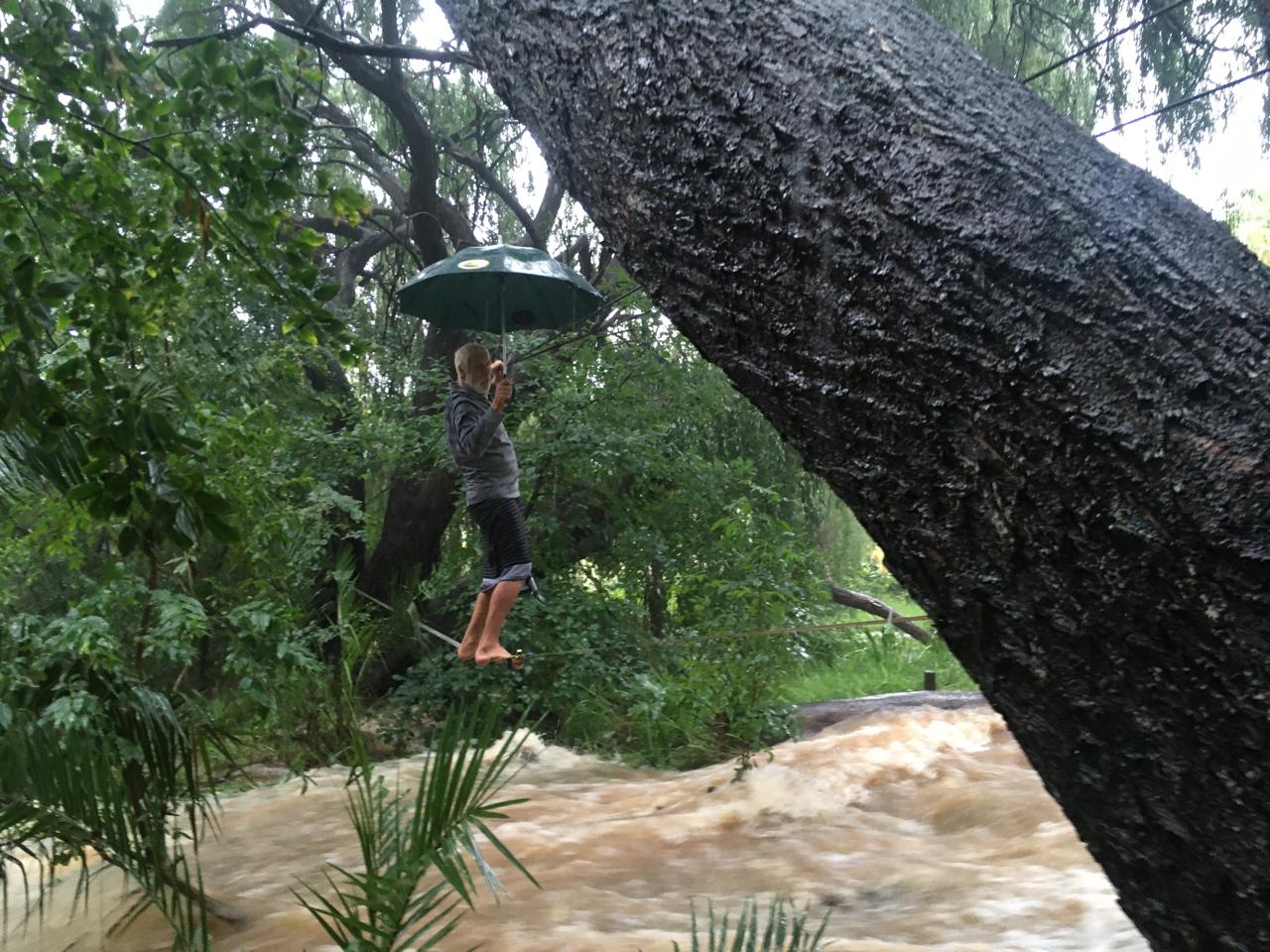
Carlswald resident Digby Hoets on a slackline above a flood of stormwater through his property. Photos: Sean Christie
On 24 March, Wilfred Mole, the chairman of the Carlswald Resident’s Association (CRA) in Johannesburg’s Midrand region, wrote an email to Johannesburg Water’s managing director Ntshavheni Mukwevho.
“A matter which can no longer be ignored,” was the subject line.
Mole proceeded to outline how, as early as 2005, Carlswald residents had informed Johannesburg Water about serious infrastructure problems in the Carlswald Valley. The main issue was the outfall sewer, which had been run down the valley alongside an episodic stream.
Mole said the line, built by a developer in the late 1990s with the permission of the then Midrand Town council, was only ever intended for use by the residents of Regents Hill, a low-density townhouse development on the eastern side of the valley, as well as the valley’s dozen or so other residents, almost all of whom live on smallholdings.
“It was privately constructed and should never have been adopted as a so-called ‘Municipal Sewer’. As ever more developments were added to this very small and inadequate sewer it began to break, block and erupt through the manholes. It now fails almost on a weekly basis,” wrote Mole, adding that the problem is exacerbated by the fact that the sewer line “was built down the middle of the valley where the main flood water goes”.
Long-time Carslwald resident Penny Hoets says that as a result of increased development in the upper catchment, “the small seasonal stream running through the valley becomes a raging torrent around 30 metres wide after highveld storms.”
“It has gouged a huge donga on properties below us. This was all exacerbated by the sewage line being constructed along the floor of the valley, where disturbed soil made it easier for the flow to gouge out deep ditches and dongas,” said Hoets.
In 2010 the sewer line failed, pouring sewage into the donga, which decanted into dams on Mole’s property, killing thousands of yellowfish.
On 20 August 2010, residents had a meeting with representatives of Johannesburg Water, which is responsible for sanitation infrastructure, and the Johannesburg Roads Agency (JRA), which is responsible for storm water management. The meeting minutes record Jane Eagle, then the City’s Open Space Planning, Environmental, and Infrastructure Services Deputy Director, lamenting that “too many developments are happening without the necessary upgrades to infrastructure taking place.” Eagle insisted she had been raising the issue of the sewer line with Johannesburg Water for five years already. Bharat Gulab, then Johannesburg Water’s head of capital projects, revealed that the water utility only had funds available for emergencies, but undertook to try and get the Carlswald sewer line on the priority list.
In March 2016, Carlswald’s residents were sent a “Final Basic Assessment Report” for a “Proposed Carlswald Sewer Pipeline”, compiled by Nemai Consulting on behalf of Johannesburg Water. A Basic Assessment report is the first step in getting an environmental authorisation from the relevant environmental authority, in this case the Gauteng Department of Environment, which must then decide if the project can proceed, or if a more thorough assessment process is required.
“We have been in touch with the engineers, and they have advised us that since that report was published, they have heard nothing further, and they assumed that the sewer project has been abandoned,” Mole wrote.
In April 2022, the Carlswald Valley sewage line collapsed into the storm water donga on a property in Milford Road, but a team from Johannesburg Water’s Midrand Depot was able to effect a temporary repair. On 14 February 2023, the line collapsed a second time, and the extent of damage led to Johannesburg Water appointing an outside contractor to undertake the repair work.
“During this time we were forced to absorb into our dams and weirs the full flow of sewage amounting to millions of litres of untreated sewage,” wrote Mole, who has turned parts of his property into an elaborate system for diverting sewage, comprising a holding dam controlled by a valve, and a concrete-lined canal which discharges into a manhole. Keeping sewage off his property and out of his dams has cost Mole more than R1-million, he claims.
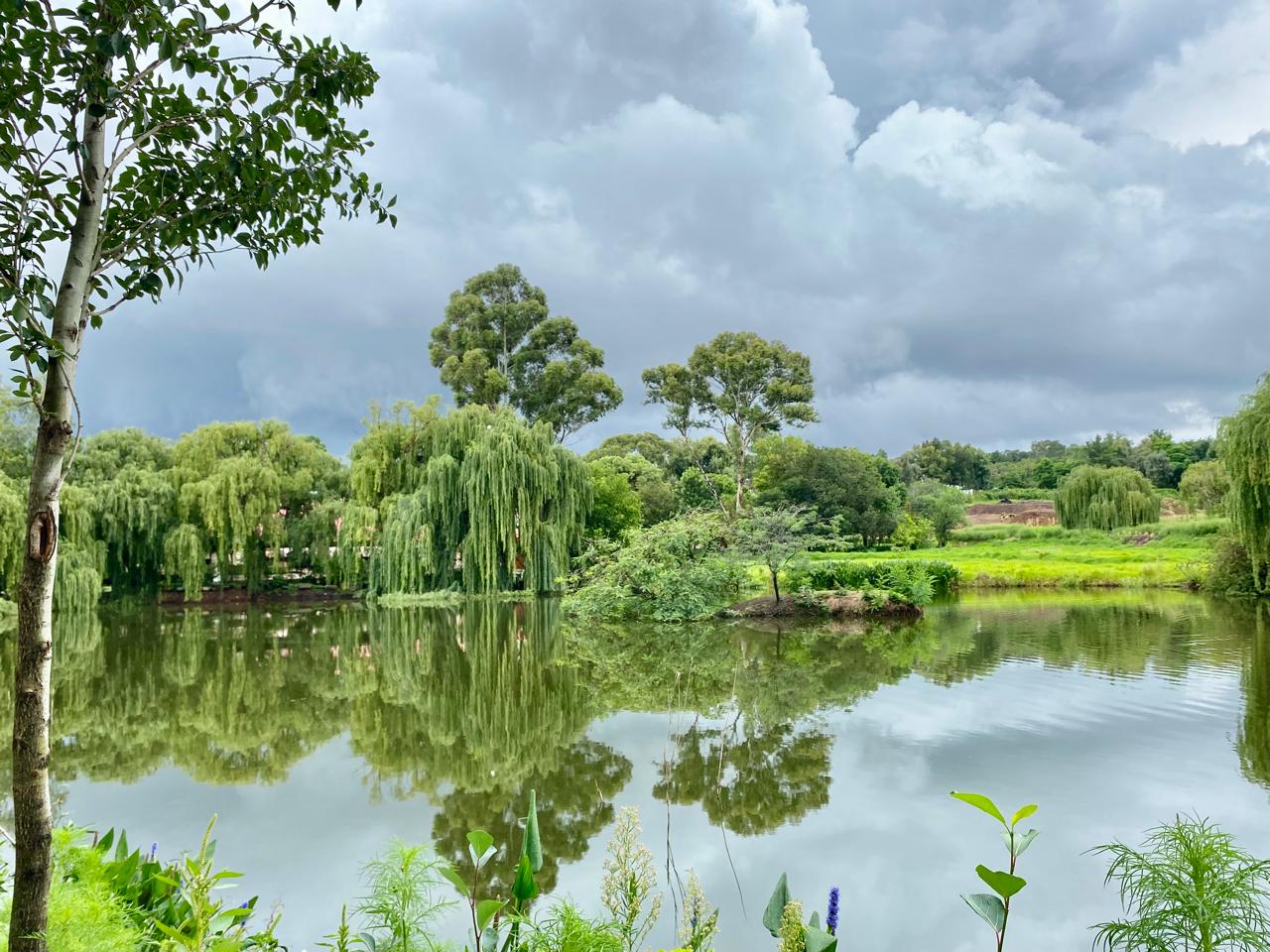
One of the dams that was flooded with sewage in 2023.
Mole concluded his letter to Mukwevho with a threat to withhold his property rates and taxes.
“Last year we paid R653,471.62 in rates and despite that, all our representations over many years were completely ignored, and all attempts to communicate were blocked. Bearing in mind your organisation’s refusal to engage with us at any level, however serious or costly the issues involved, we no longer have any moral or legal responsibility to honour obligations to your department.”
Mole received no response, and has since made good on his threat.
In their response to GroundUp, Johannesburg Water’s Nombuso Shabalala said there is a plan in motion to upgrade the sewer line, which would see Johannesburg Water “re-route the proposed new sewer line away from the stream to prevent the risk of the new infrastructure being washed away after installation. This also involves installation of erosion protection works on some sections where re-routing of the pipe away from the stream becomes impractical. It is expected that the procurement of the project will commence early February 2026 with the award of the contract planned for August 2026.”
Asked why it has taken more than 20 years to implement a solution, Shabalala insisted that Johannesburg Water “has been implementing this project with urgency” but had struggled with the fact that the sewer line “traverses through private properties without a registered servitude and access for maintenance purposes”.
“Johannesburg Water commenced the process of registering servitude in March 2016. However, challenges were encountered where some property owners were not accepting the proposed valuated amounts for land compensation or it was difficult to get hold of them. Johannesburg Water is currently seeking consent from four landowners who have not yet signed,” she said.
Engineer Koos Smit is one of the residents holding out.
“My objection is simple. They say it is an upgrade of an existing line when in fact it will need to follow a completely new route, so it isn’t an upgrade, it’s a new project. I contend that whatever environmental permissions have been secured to move ahead with this project are therefore based on a lie. I am not against infrastructure upgrades and development, it must just be done transparently, following the correct process.”
The issue appears to be deadlocked.