23 September 2026
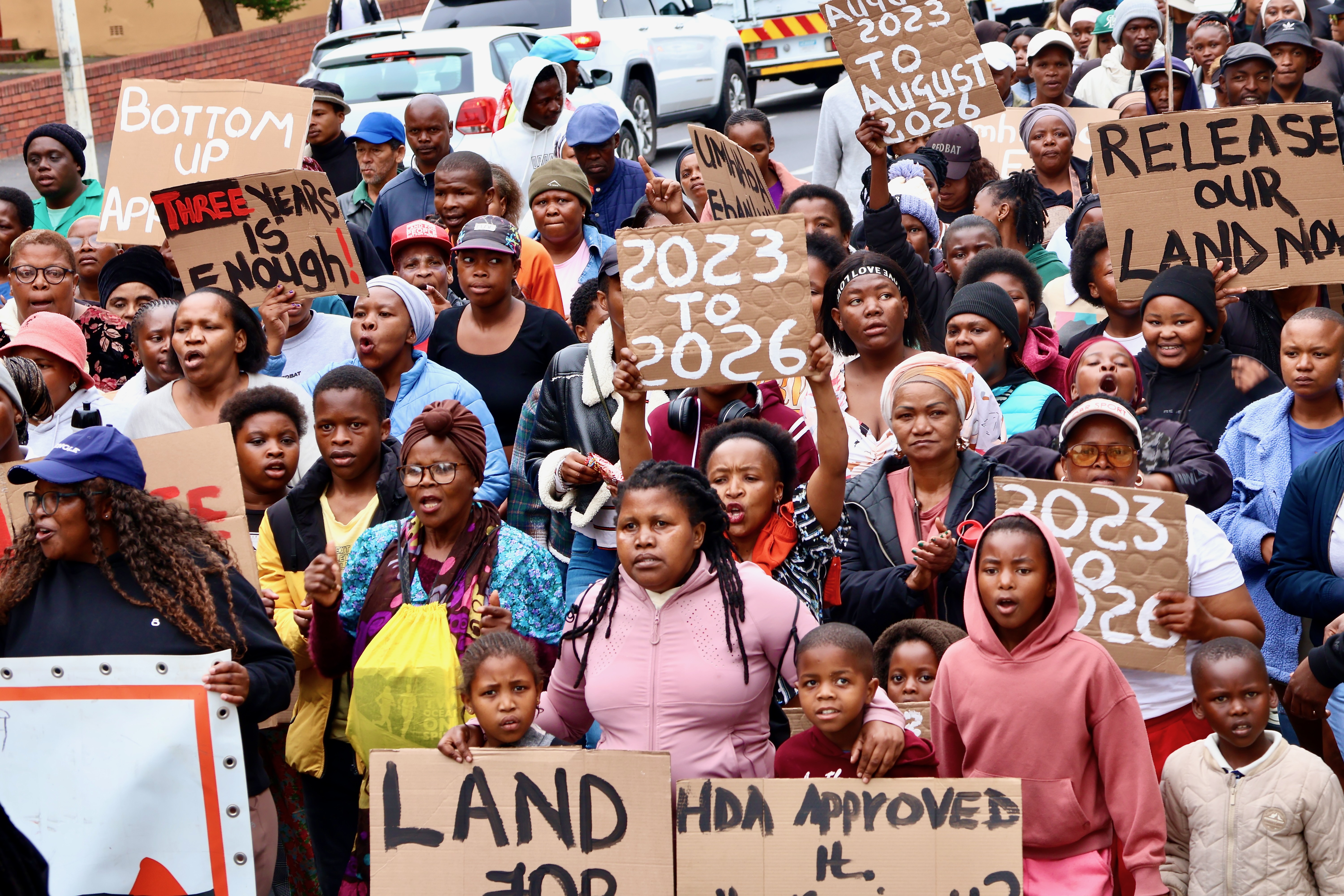
Activists marched to Parliament, demanding updates on their applications for the release of 24 parcels of state-owned land. Photo: Matthew Hirsch
Scores of people marched to Parliament on Wednesday, demanding the release of state-owned land for housing.
More than three years ago, people marched to the president’s residence in Cape Town, calling for him to release 32 parcels of state-owned land using his powers under the State Land Disposal Act.
The Act gives the president the power to donate, sell, lease or exchange any piece of public land in the country. In May 2024, President Cyril Ramaphosa instructed the ministers of human settlements and public works to investigate the demands.
Communities later submitted formal applications for 24 parcels of state land in the Western Cape, Gauteng and KwaZulu-Natal. The Housing Development Agency (HDA) identified 12 sites as suitable for housing. Most of these sites remain vacant and undeveloped.
On Wednesday, placards read “three years is enough” and “release our land now”.
Luyanda Mtamzeli of Ndifuna Ukwazi told the crowd that marching to Parliament to get answers was a last resort.
Lia Wells of the Surplus People Project said they had, in 2023, submitted an application in Clanwilliam for a collective of small-scale farmers. The HDA approved it, but there has been no movement since.
“The delay is not neutral. It’s a human rights violation to leave communities with hope, to leave communities with the promise that the circumstances will change, but for no institutional justice or administrative justice to take place,” said Wells.
Housing Assembly secretary Asakhe Mzini emphasised the urgent need for housing. “We find communities in Khayelitsha … people are living on wetlands. Come winter, you go to work and come home to find your house floating. The issue of land is a serious issue. It is our home,” he told GroundUp.
“The government cannot ask communities to follow every rule of the process while ignoring its own obligation to communicate,” the organisers said in a statement. “Communities have waited three years for an answer. They should not have to wait a fourth.”
Members of Parliament’s Portfolio Committee on Human Settlements addressed the marchers outside Parliament. Sello Dithebe (ANC) said he had raised the issue at a committee meeting earlier that morning. He said the committee was told that a technical working group on the matter had been set up.
GroundUp sent questions to the Department of Public Works, Human Settlements and the Presidency. Responses will be added if received.
Tsekiso Machike, Spokesperson to the Minister of Human Settlements, responded after publication. “We fully understand people’s frustration and what they demand of us. However, we appeal for their patience and understanding, as the acquisition of immovable properties is a process and takes time.”
“In the current financial year, we have committed ourselves to promoting the repurposing of well-located government buildings into affordable rental stock, where feasibility and bulk infrastructure permit.”
“Since the submission, we have had several meetings with the affected stakeholders, including the Presidency, the Department of Public Works and Infrastructure, and Non-Governmental Organisations.”
