1 October 2026
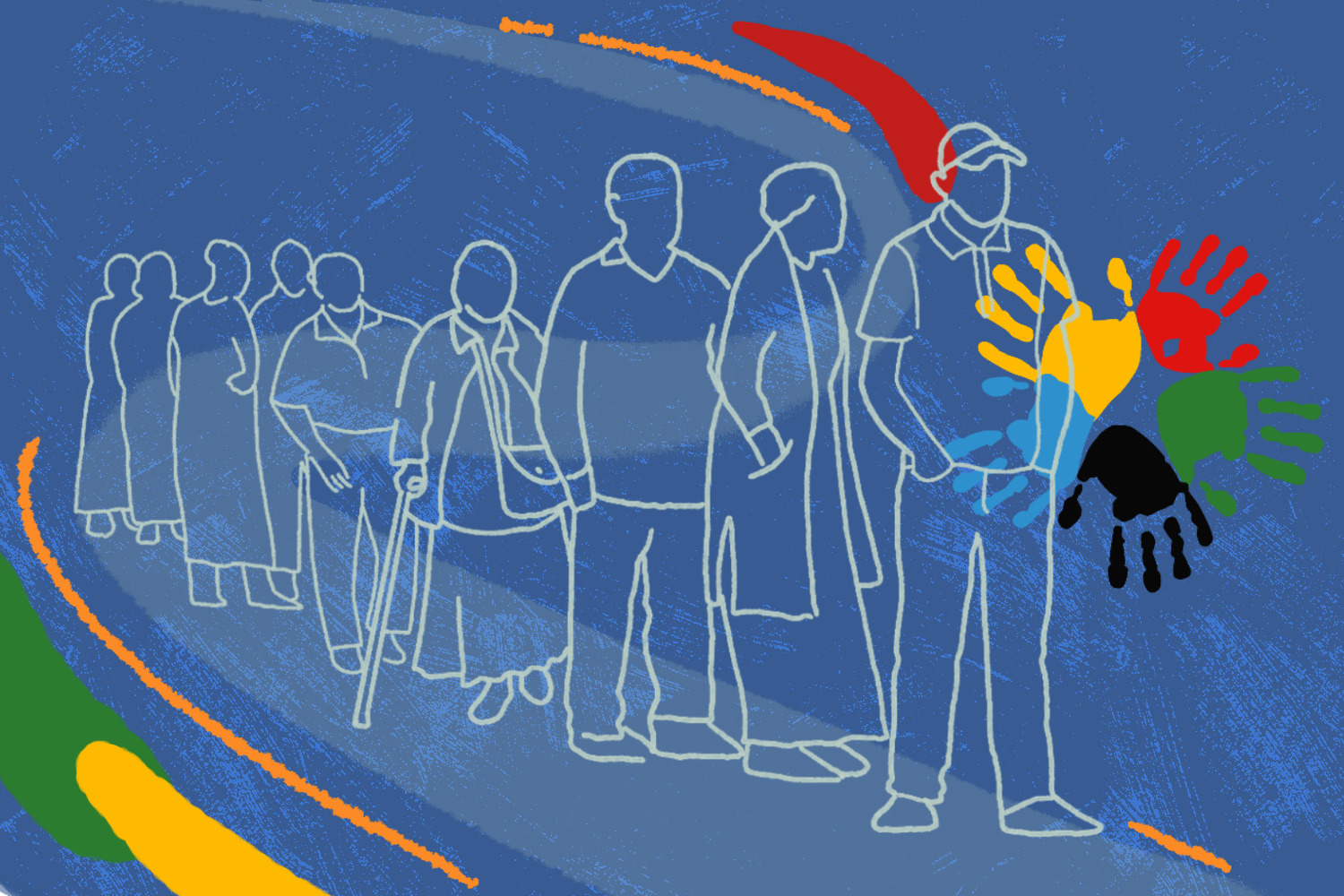
The Social Relief of Distress grant was introduced in 2020 as a temporary measure to offset the effects of the covid lockdown. Six years later, millions of people still rely on the grant for survival. Graphic: Lisa Nelson
This is the first in a short series looking back over 20 years of SASSA.
When the government announced the Social Relief of Distress (SRD) grant in 2020, it was meant to be a temporary response to the covid crisis. More than six years later, millions of people still depend on it.
The grant has survived the end of the state of disaster, a break in payments, court challenges and a major fraud problem.
It has also raised a question of whether paying unemployed adults discourages them from looking for work. New research suggests that it does not.
President Cyril Ramaphosa announced the grant on 21 April 2020 as part of a R500-billion covid response. Lockdown had wiped out many informal livelihoods.
Before 2020, the grants were aimed mainly at children, older people and people with disabilities. Nothing existed for working-age adults without work. The government’s initial plan was to pay the grant to eight million people for six months.
By 25 May 2020, the South African Social Security Agency (SASSA) had received about 13-million enquiries and applications, of which 6.3-million were valid and complete. Yet by 31 May, only 116,867 people had been paid.
The gap between applications and payments came down to the way the grant was checked. Every application was checked against the Unemployment Insurance Fund, SARS, National Student Financial Aid Scheme and social grant databases to make sure the applicant did not have an income above the R595 threshold.
The checks also caused problems of their own. Of the 3.3-million rejected applications, 2.1-million failed because the applicant appeared on the UIF database, but SASSA later said that up to 85% of those rejections may have been wrong.
For those who were approved, getting the money was another struggle. Many people collected it at post offices, where they queued for hours, often in the rain. GroundUp reported that some people paid R50 bribes to be served first, while others paid between R50 and R150 for someone to queue overnight for them.
The grant was extended several times during the pandemic but ended on 30 April 2021.
Civil society groups campaigned for the grant to be reintroduced as a basic income grant. On 25 July 2021, Ramaphosa announced that the grant would be reinstated until March 2022. It now also covered unemployed caregivers who received the child support grant.
SASSA said roughly eight million applications had been approved at the time.
The second break was more technical. When the state of disaster ended, administration of the grant had to move under the Social Assistance Act. From April 2022, no new applications were processed while the new system was being put in place.
Everyone had to re-apply, and for the first time all applicants faced a monthly bank-account means test. Anyone receiving R350 or more per month could be disqualified.
The Department of Social Development said it had a R44-billion budget to reach 10.5-million people, and had introduced the test to keep within that amount. But under the new rules, only 5.2-million people qualified.
Payments for the new cycle only began in mid-June 2022, because SASSA first had to procure banking services for the checks. The #PayTheGrants campaign called the delay “a deliberate act of cruelty”.
The rules were eventually eased. In August 2022, the income threshold was raised to R624, the food poverty line at the time. By October 2022, about 7.5-million people were being paid each month.
Despite the problems, the grant became a fixture of the social assistance landscape. It rose from R350 to R370 in April 2024.
The scale of the programme made it a target for fraud.
In October 2024, two Stellenbosch University computer science students, Joel Cedras and Veer Gosai, found serious weaknesses in SASSA’s online application system.
They found that fraudulent SRD applications were being made using ID numbers of individuals who had recently turned 18.
SASSA’s grant operations head Brenton van Vrede acknowledged that there were “quite a lot of these cases” and advised people who believed their identities had been used to undergo biometric verification.
The response created another problem. Many legitimate beneficiaries struggled to complete the checks, especially those with old green ID books, and some waited months to regain access to their grant.
Meanwhile, the rules were challenged in court. In January 2025, the Pretoria High Court ruled that several regulations were unconstitutional, including online-only applications, the income threshold and the grant amount. The court ordered government to raise both the grant and the threshold over time.
The government has appealed the judgment and the Supreme Court of Appeal is to hand down a decision.
Researchers Tim Köhler, Ben Stanwix and Haroon Bhorat at the University of Cape Town’s Development Policy Research Unit examined the grant’s effects on employment and job-seeking, using survey data from 2021 and 2022.
They found that receiving the grant increased the probability that people would look for work by 3.4 percentage points. The probability that they would attempt to start a business increased by 1.5 percentage points. These effects meant that the probability of employment increased by 2.2 percentage points.
The researchers say the grant may ease some of the financial pressure involved in looking for work, including transport, communication and other costs.
The effect on employment was strongest in the first three months after people began receiving the grant, when their chance of finding work increased by 2.6 percentage points. After seven to nine months, the researchers could no longer detect a clear effect on employment.
The researchers say this does not mean people stopped looking for work. Instead, they argue, the shortage of jobs and limited opportunities for self-employment make it difficult for increased job-seeking to translate into lasting employment.
Losing the grant had the opposite effect: the average recipient’s probabilities of job search fell by 7.2 percentage points and the probability of employment by 2.9 percentage points.
“From a policy perspective this suggests that removing the grant from the system without an equivalent substitute is likely to worsen aggregate labour market outcomes,” the researchers say.
The researchers conclude that the grant works as income relief but falls short as a route into work. They propose a “cash-plus” approach that combines income support with measures such as skills training, public employment or business start-up support.